Digital Twins
Forward Deployed Engineering in Manufacturing: Bringing AI to the Factory Floor

Aze Zunnisa
September 24, 2026
Forward Deployed Engineering in Manufacturing: Bringing AI to the Factory Floor
Why the next generation of industrial intelligence requires engineers who understand both technology and the environment where it operates
Manufacturing has never lacked data.
Modern plants already generate information from machines, sensors, PLCs, SCADA systems, MES platforms, ERP systems and operational processes. The challenge is no longer collecting information.
The challenge is making that information useful when a real decision needs to be made.
A machine may generate thousands of signals every minute. A dashboard may display hundreds of metrics. An AI model may identify a pattern.
But the factory still needs an answer:
What does this mean, and what should we do next?
This is where many industrial AI initiatives face their biggest challenge. Moving from a successful demonstration to a reliable production system requires much more than building a model.
It requires understanding the environment where that technology will operate.
That is where Forward Deployed Engineering (FDE) becomes important.
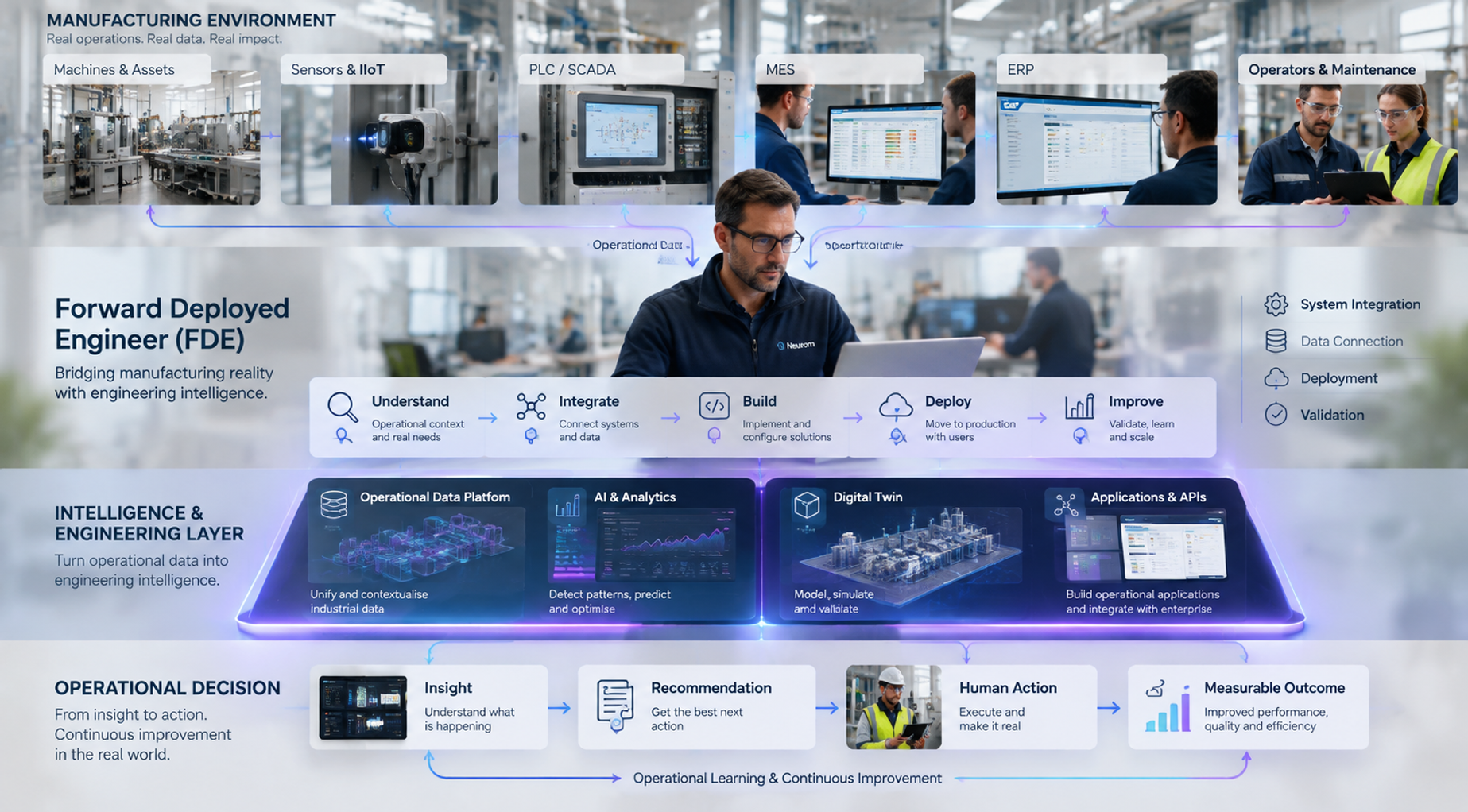
Forward Deployed Engineering is an approach where engineers work close to the operational environment, connecting real-world problems with engineering solutions. Instead of building technology separately and handing it over later, FDE brings together system understanding, integration, development, deployment and continuous improvement.
In manufacturing, this means bringing engineering closer to the factory floor.
The Gap Between AI Pilots and Production Systems
Many industrial AI projects begin with a promising idea.
A manufacturer wants to reduce machine downtime, improve quality inspection or optimize production performance. A prototype is developed, the data looks promising and the technology demonstrates potential.
But production environments introduce realities that are difficult to reproduce during a pilot.
A machine may use older communication protocols. Data may come from multiple systems. Different teams may own different parts of the process. Network and security requirements may restrict how systems can connect.
Most importantly, the solution has to fit into how people actually work.
For example, consider a manufacturing plant trying to predict failures in a critical production motor.
Your Factory Has Data. Why Are Decisions Still Delayed?
Building a prediction model is only one part of the challenge.
The engineering team still needs to understand:
How is the motor operated?
Which signals indicate a real problem?
How do maintenance teams currently respond?
Where should the recommendation appear?
Who makes the final decision?
How does the solution integrate without affecting production?
The difficult part is not only predicting failure.
The difficult part is creating a system that helps people take the right action at the right time.
Why Manufacturing Needs FDE
Traditional technology projects often follow a sequence:
Build → Demonstrate → Handoff
This approach can work when requirements are already clear.
Manufacturing environments are different.
The requirements often become clearer only after engineers understand the actual operation.
A Forward Deployed Engineer works across these boundaries.
They understand the production environment, connect existing systems, identify technical constraints, build the required solution and validate it under real operating conditions.
The role sits between multiple worlds:
- Factory operations
- Industrial systems
- Software engineering
- Data platforms
- AI capabilities
- Human workflows
This connection is what helps transform an idea into something that can operate reliably.
From Factory Data to Operational Decisions
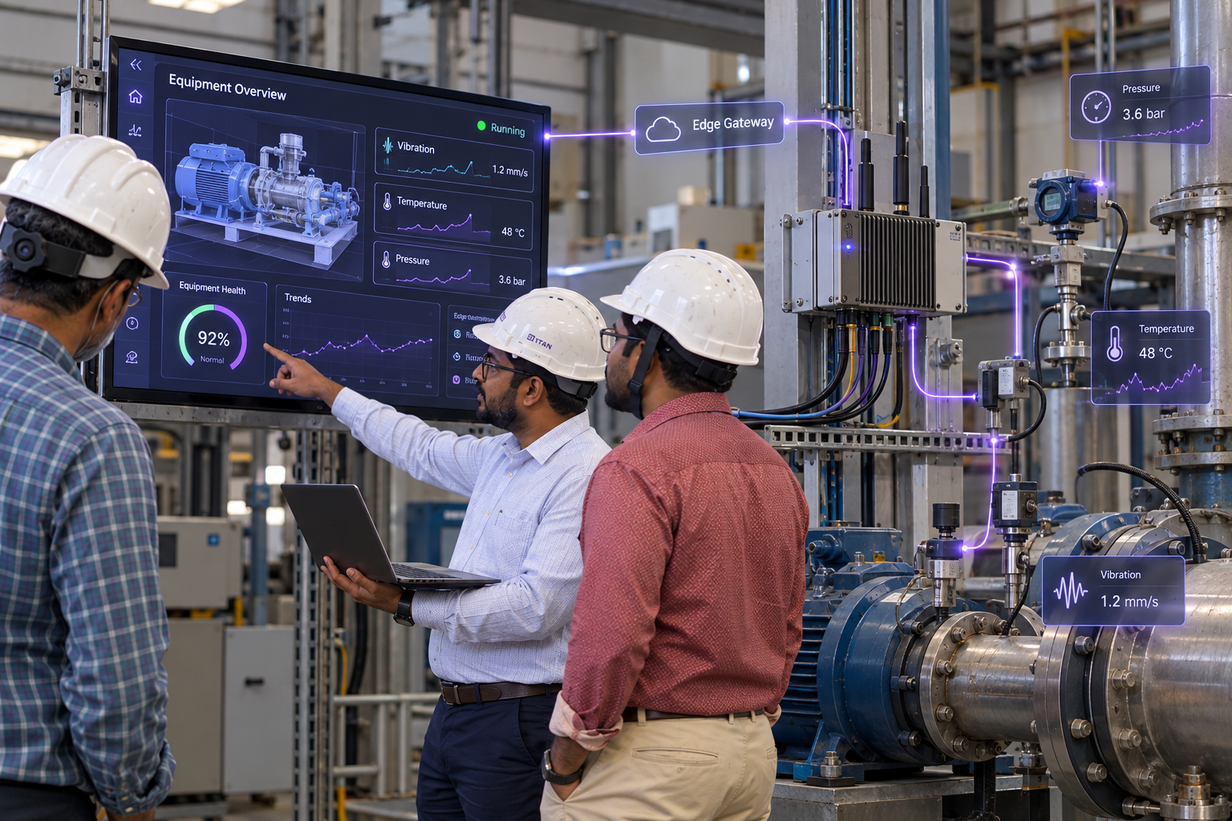
A manufacturing environment already contains multiple layers of information.
Machines generate signals. Industrial systems store operational data. Enterprise platforms manage processes. Engineers and operators bring years of practical knowledge.
The role of FDE is to connect these layers.
Depending on the problem, the solution may involve IoT integration, analytics, AI, Digital Twins, automation or software systems.
The technology is not selected first.
The operational challenge comes first.
A factory does not need AI because AI exists.
It needs intelligence when a decision is difficult, slow or dependent on manual interpretation.
FDE Is More Than AI Deployment
The current discussion around Forward Deployed Engineering is strongly connected with enterprise AI, but the approach applies much wider than AI models.
Some manufacturing problems require better data collection.
Some require connecting disconnected systems.
Some require operational analytics.
Some require Digital Twins that represent the behaviour of physical assets.
Some require AI-based recommendations integrated into existing workflows.
The role of FDE is to understand where intelligence can create value and engineer the complete solution around that requirement.
Why Deployment Is the Hardest Part
A prototype environment is controlled.
A factory is not.
Real production environments have constraints:
Existing equipment cannot always be replaced.
Production cannot stop for experimentation.
Data may not always be clean.
Security requirements may limit connectivity.
Operators need systems that support decisions without adding unnecessary complexity.
This is why industrial intelligence is not only a software problem.
It is a systems engineering problem.
The technology must work with the environment, not expect the environment to change completely.
AWS describes its Forward Deployed Engineering approach around embedding engineers with customers to help move AI solutions into production environments using real data, processes and operational constraints. AWS has also highlighted manufacturing applications of this approach through its work with Jabil.
Accenture's Forward Deployed Engineering initiatives with enterprise partners similarly focus on helping organizations move AI from experimentation into integrated production systems.
The Future of Industrial Intelligence
Manufacturing will not become intelligent simply by adding more sensors, more dashboards or more AI models.
The real challenge is connecting technology with operational reality.
The systems that create value will be the ones that understand the environment, integrate with existing operations and support people when decisions matter.
At Neurom Innovations, we approach Forward Deployed Engineering as a way to bring engineering closer to complex operational problems.
Our FDE capabilities combine requirement analysis, system integration, development, deployment, troubleshooting, training and continuous improvement to help organizations move from concept to operational systems.
By combining AI, IoT, Digital Twins and enterprise software engineering, we help build systems designed for real-world environments.
Because the future of industrial intelligence will not be defined only by better technology.
It will be defined by technology that works where decisions actually happen.
Frequently Asked Questions
What is Forward Deployed Engineering in manufacturing?
Forward Deployed Engineering is an approach where engineers work closely with the operational environment to solve real-world technology challenges. In manufacturing, an FDE connects factory systems, operational data, software platforms and emerging technologies to build solutions that work within existing production environments.
Unlike a traditional development approach that builds separately and delivers later, FDE stays connected with the operation through integration, deployment, validation and continuous improvement.
What does a Forward Deployed Engineer do?
A Forward Deployed Engineer helps translate an operational problem into a working technical solution.
In a manufacturing environment, this can involve understanding existing processes, connecting industrial systems, integrating data sources, developing software or intelligence capabilities, deploying the solution and working with engineering teams to improve it after deployment.
The role requires understanding both the technology and the environment where that technology needs to operate.
How is FDE different from traditional consulting?
Traditional consulting often focuses on analysis, recommendations and strategic direction. The implementation phase may happen separately.
FDE focuses on moving from understanding the problem to building and deploying the solution. The engineer works closer to the operational team, deals with real system constraints and remains involved through execution.
The difference is not only providing recommendations, but helping turn those recommendations into operational capability.
How does FDE help deploy AI in manufacturing?
AI deployment in manufacturing involves more than developing a model.
An FDE helps connect AI capabilities with real factory systems, including sensors, industrial data sources, software platforms and existing workflows. This helps ensure that AI outputs are relevant, accessible and useful for the people making operational decisions.
The focus is on moving AI from a prototype environment into a reliable production system.
Is FDE useful for Digital Twin and IoT projects?
Yes. Digital Twin and IoT projects often require integration between physical assets, operational data and software systems.
An FDE can help understand the operational requirement, connect data sources, integrate platforms and ensure that the resulting system supports real decisions.
For example, a Digital Twin is valuable not only because it represents an asset digitally, but because it connects asset behaviour, operational data and decision workflows.
Have a manufacturing challenge that needs to move from concept to production?
- Forward Deployed Engineering
- Manufacturing AI
- Industrial AI
- Digital Twin
- Industrial IoT
- Operational Intelligence