IoT
Your Factory Has Data. Why Are Decisions Still Delayed?

Aze Zunnisa
July 31, 2026
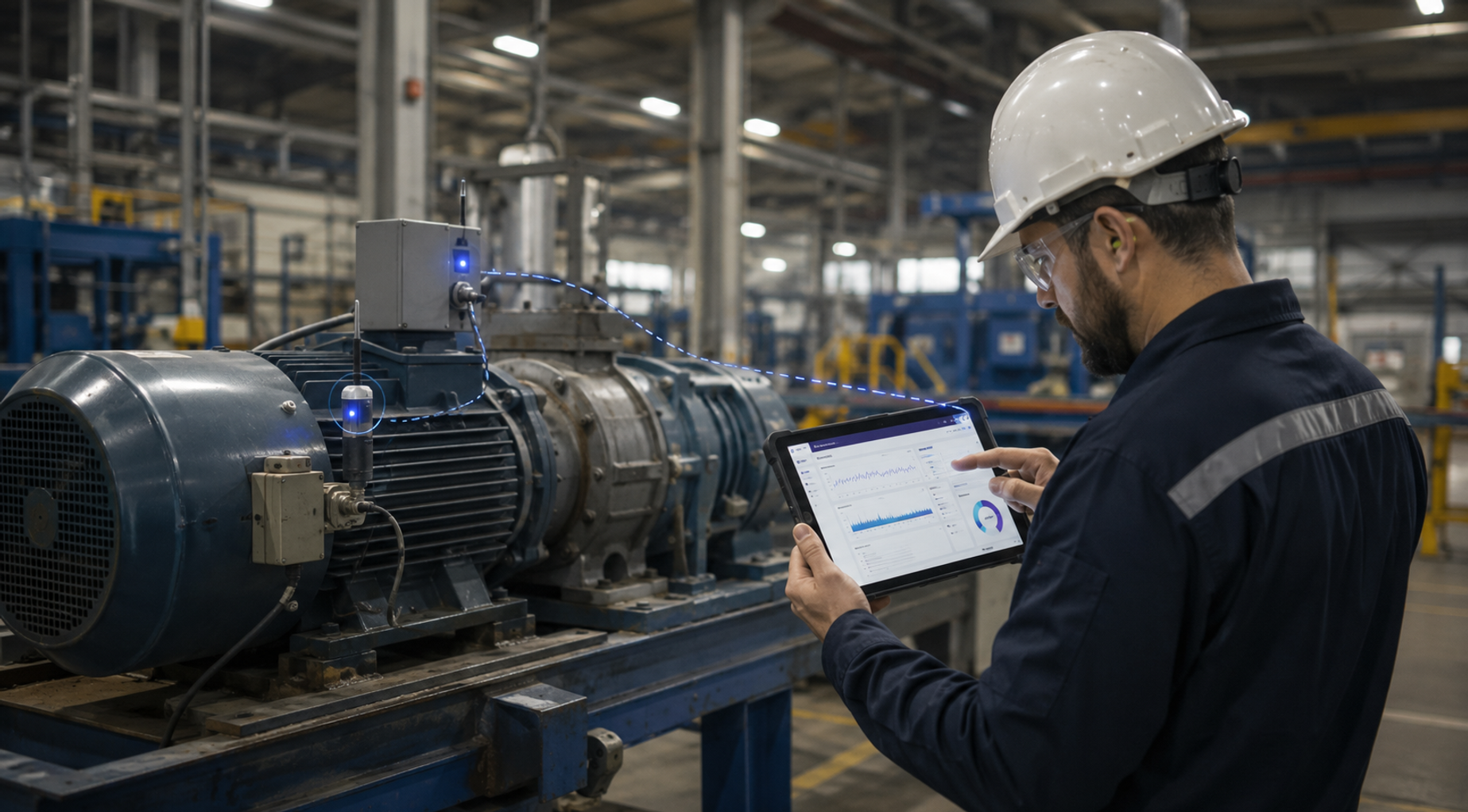
A machine begins operating outside its normal temperature range.
The sensor detects it. SCADA displays it. An alert may even be generated.
But the maintenance team still has questions. Is the increase abnormal for the current operating load? Has it happened before? Was the machine recently serviced? Does it require an immediate shutdown or only an inspection?
The factory has the data, but the decision is still delayed.
Industrial organizations have invested in sensors, automation systems, dashboards and enterprise platforms. Yet important information often remains fragmented across systems and departments.
The next stage of industrial digitalization is not collecting more data. It is connecting existing data with operational context so teams can understand what is happening and decide what to do next.
Visibility Is Not the Same as Intelligence
SCADA systems are essential for monitoring processes, generating alarms and controlling equipment. Dashboards help teams track production, downtime, energy consumption and maintenance indicators.
However, both primarily improve visibility.
They may show that a motor is overheating, a pump is losing pressure or energy consumption has increased. But displaying a change is different from understanding it.
Operational intelligence connects the live condition of an asset with:
- Normal behaviour under the current operating load
- Previous failures and maintenance records
- Relationships with connected equipment
- Engineering limits and applicable SOPs
- Production and safety impact
- The person responsible for taking action
This is where a Digital Twin can create value.
A Digital Twin Is Not Just a 3D Model
Digital Twins are often presented as 3D replicas of factories or machines.
A 3D environment can help engineers locate components, practise procedures, conduct virtual inspections and understand how systems are connected. But visual accuracy alone does not create a Digital Twin.
A 3D model represents how an asset looks.
An operational Digital Twin should represent what the asset is doing, how it normally behaves, how its condition has changed and what action may be required.
The visualization is only one possible interface. The real value sits beneath it:
Asset Data → Operational Context → Intelligence → Decision → Action
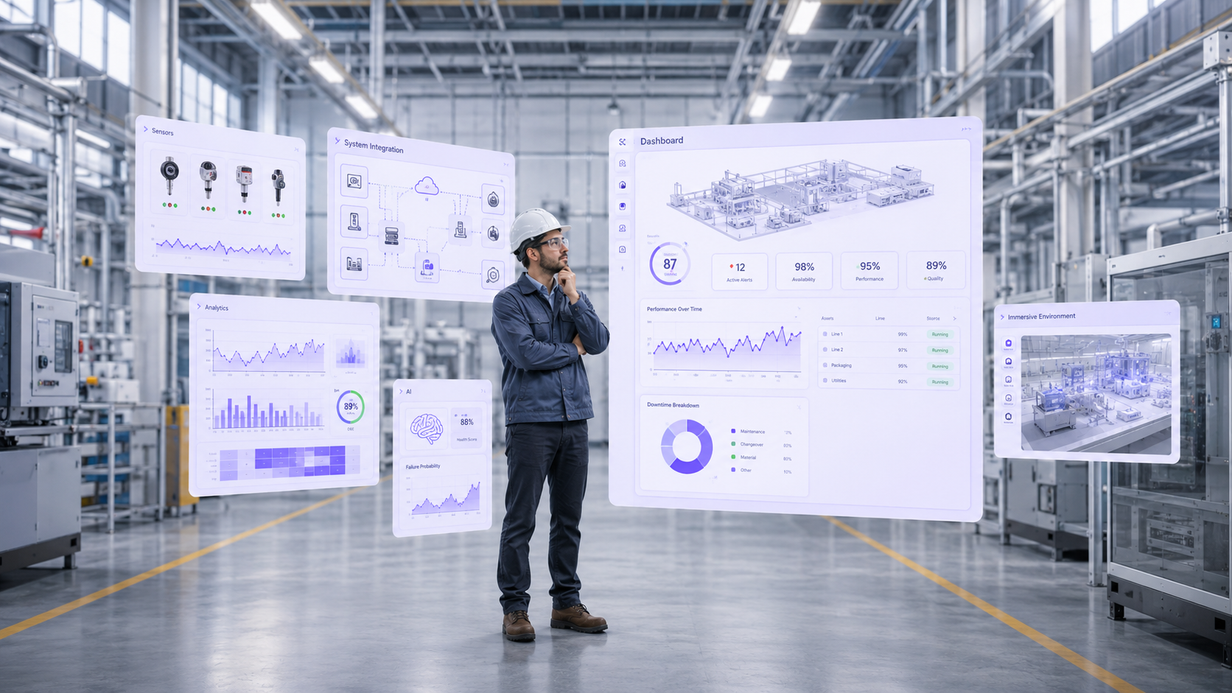
Some use cases benefit from immersive 3D or VR. Others require a clear dashboard supported by strong data modelling and decision logic. The interface should follow the operational requirement.
From an Alert to an Action
Consider a hypothetical industrial pump.
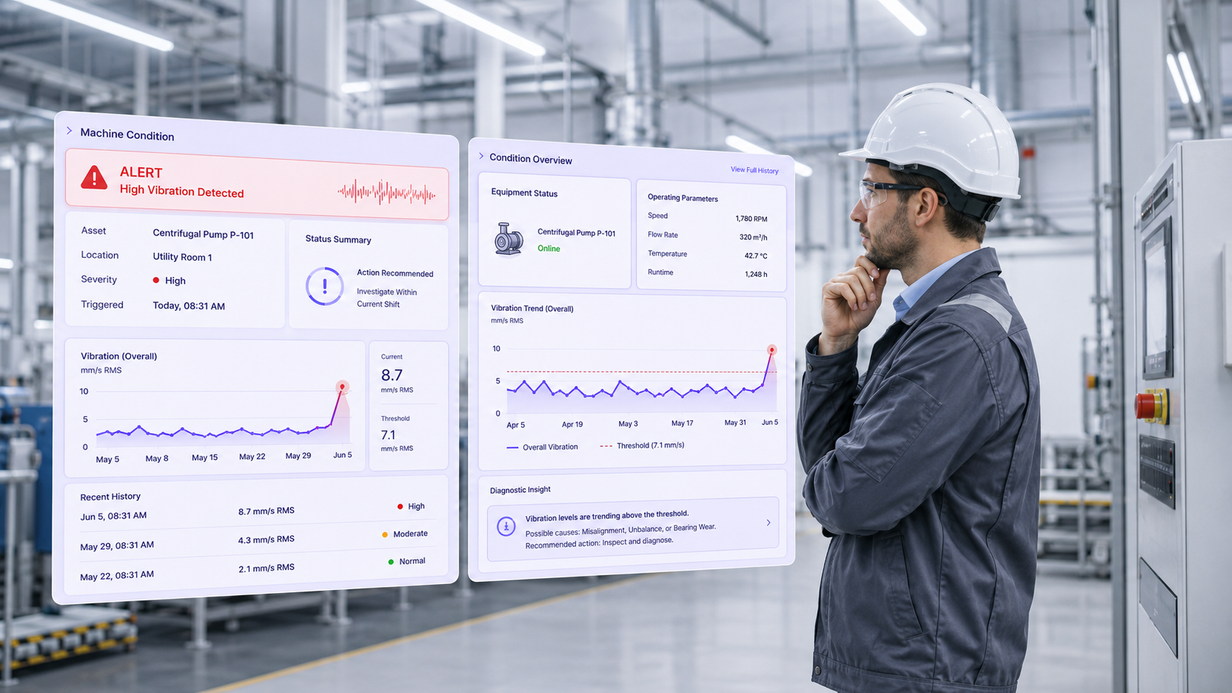
A vibration sensor detects an unusual reading. A conventional monitoring system displays the value and generates an alert after it crosses a threshold.
A connected operational system could compare the vibration with the pump’s normal performance under the current load. It could review previous maintenance records, correlate the change with temperature and pressure, identify whether similar conditions preceded an earlier failure and present the appropriate inspection procedure.
The maintenance engineer receives more than an alarm. They receive the context needed to judge the situation.
An alert says something changed. Operational intelligence helps explain what that change means.
This does not mean every alert should trigger an AI prediction or automated response. In industrial environments, recommendations must remain traceable, understandable and aligned with engineering and safety procedures.
Why Digital Twin Projects Fail
Many Digital Twin initiatives begin with technology instead of an operational problem.
An organization may decide to build a 3D factory, connect every sensor or introduce AI before identifying the decision the system should improve.
The result may look impressive during a demonstration but create limited value in daily operations.
A Digital Twin project needs a clear purpose, such as detecting abnormal equipment behaviour earlier, improving maintenance prioritization, reducing diagnosis time or providing safer SOP training.
Without a defined problem, responsible user and measurable outcome, the Digital Twin becomes another disconnected platform.
Neurom’s Approach: Begin With the Decision
At Neurom Innovations, we view Digital Twins as decision-support systems-not visualization projects.
The starting point should be one operational question:
Can the maintenance team identify early signs of equipment degradation before it interrupts production?
Once the question is clear, we identify the relevant asset, available information, missing context, responsible decision-maker and measurable outcome.
Only then should an organization decide whether the solution requires new sensors, system integration, analytics, AI, a dashboard or an immersive environment.
This keeps the implementation connected to a real operational need.
AI Is Not Always the First Requirement
AI and predictive analytics can strengthen a Digital Twin, but only when the data and problem justify them.
Some industrial problems can initially be addressed using engineering thresholds, equipment specifications, historical baselines, trend analysis and relationships between multiple sensor readings.
Machine learning becomes useful when sufficient historical data, repeatable patterns and a clear prediction target are available.
Using AI without reliable data or engineering context can produce recommendations that operators cannot trust. The objective is not to use the most advanced technology. It is to use the appropriate technology for the decision being improved.
Start With One Asset and One Problem
An organization does not need to digitize the entire factory at once.
A practical pilot can begin with one operationally important asset, one recurring problem and one measurable KPI.
The team can map existing data, establish the current performance baseline, build the required operational context and validate whether the resulting insights improve the decision.
The KPI may be downtime, maintenance-response time, energy consumption, inspection effort, training time or process deviation.
If the pilot creates measurable value, the system can then expand to additional assets and facilities.
Turning Industrial Data Into Timely Action
Industrial organizations
already possess valuable data. The problem is that this information is often separated from the context and people required to use it.
A useful Digital Twin closes that gap.
It connects physical assets with operational data, engineering knowledge and decision workflows-helping teams move from seeing that something changed to understanding why it matters and what should happen next.
At Neurom Innovations, we design connected operational systems that bring together industrial data, engineering context and decision workflows.
Have one asset or process where data exists but decisions are still delayed?
Discuss your use case with Neurom: hello@neurom.in www.neurominnovations.com
- Operational Intelligence
- SCADA
- Industrial IoT
- Predictive Maintenance
- Industrial Data