Digital Twins
From Data to Decisions: Engineering Intelligent Systems for Complex Operations

Aze Zunnisa
August 29, 2026
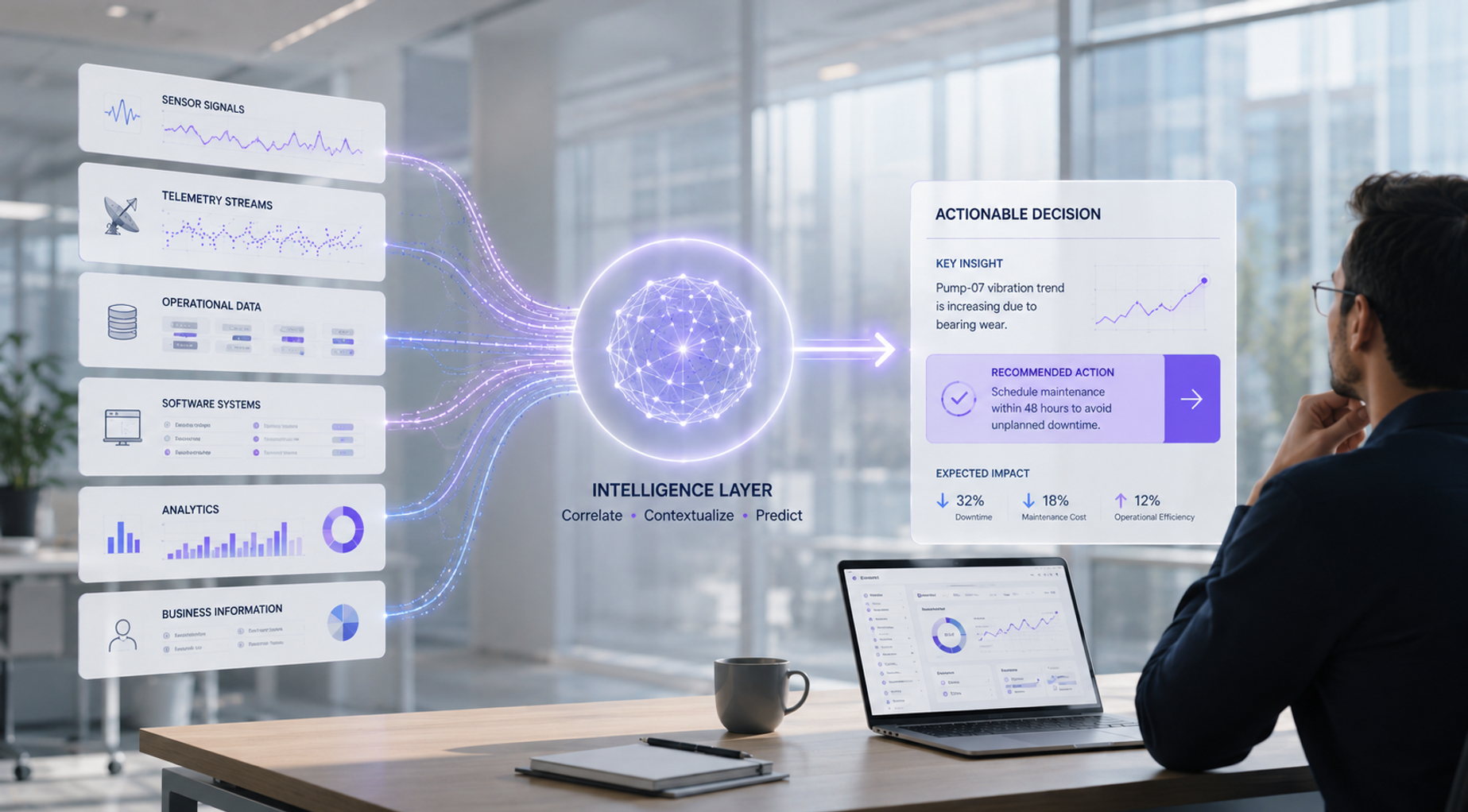
From Data to Decisions: Engineering Intelligent Systems for Complex Operations
Why organizations need more than data, dashboards and AI models to make reliable decisions
Every complex system generates data.
A satellite produces telemetry. A manufacturing plant produces machine signals. A connected infrastructure system produces operational information every second.
Today, collecting data is no longer the biggest challenge.
The real challenge is understanding what that data means and deciding what action should follow.
While working on software systems across space technology, industrial platforms and enterprise applications, we have observed a common pattern:
Organizations rarely struggle because they lack information. They struggle because the right information does not reach the right person with enough context to make a confident decision.
That gap between data and action is where intelligent systems create value.
Data Alone Does Not Create Intelligence
A sensor can detect a change.
A dashboard can display that change.
But a decision requires understanding.
Consider an industrial machine.
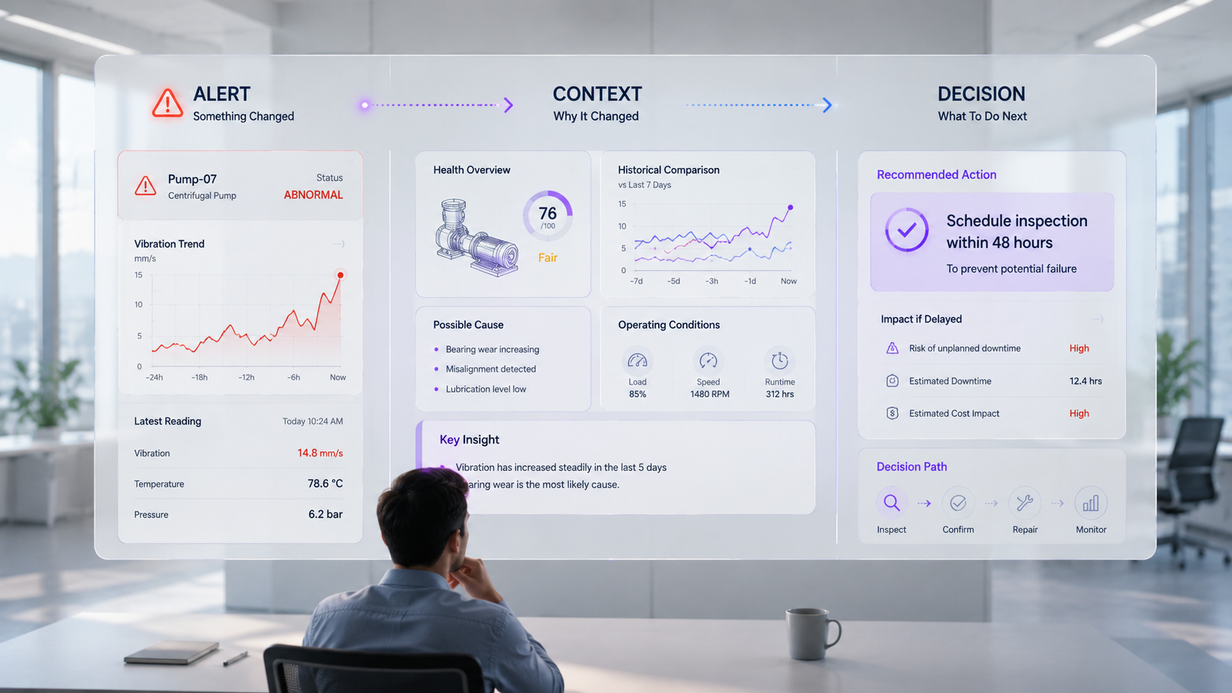
A vibration sensor detects an unusual pattern. The monitoring system generates an alert.
The engineer still needs answers:
- Is this behaviour abnormal?
- Has this happened before?
- What caused the change?
- How urgent is the situation?
- What action should be taken?
The answer does not exist in a single data point.
It requires combining operational data with context, engineering knowledge and system behaviour.
That is the difference between monitoring a system and understanding it.
The Missing Layer Between Data and Decisions
Modern organizations already have multiple technology layers:
- Sensors collecting information
- SCADA systems monitoring operations
- Enterprise systems managing processes
- Dashboards showing performance
- Analytics platforms identifying trends
These systems provide visibility.
But visibility alone does not always create action.
An intelligent operational system connects:
Physical Systems → Data → Context → Intelligence → Decision → Action
The objective is not to create more information.
The objective is to help people make better decisions.
Dashboards, Digital Twins and AI: Tools, Not the Destination
Dashboards, Digital Twins, IoT and AI are powerful technologies.
However, they are not the final outcome.
They are engineering tools used to solve operational problems.
A dashboard can show that energy consumption increased.
An intelligent system helps understand:
- Which asset caused the change
- Whether it is expected
- What factors influenced it
- What action can improve performance
A Digital Twin can represent an asset digitally, but its real value comes from connecting the physical condition, operational data and expected behaviour of that asset.
AI can identify patterns and support predictions, but only when the system has reliable data and meaningful context.
The right question is not:
"Where can we add AI?"
The right question is:
"Which decision can become faster, safer or more reliable?"
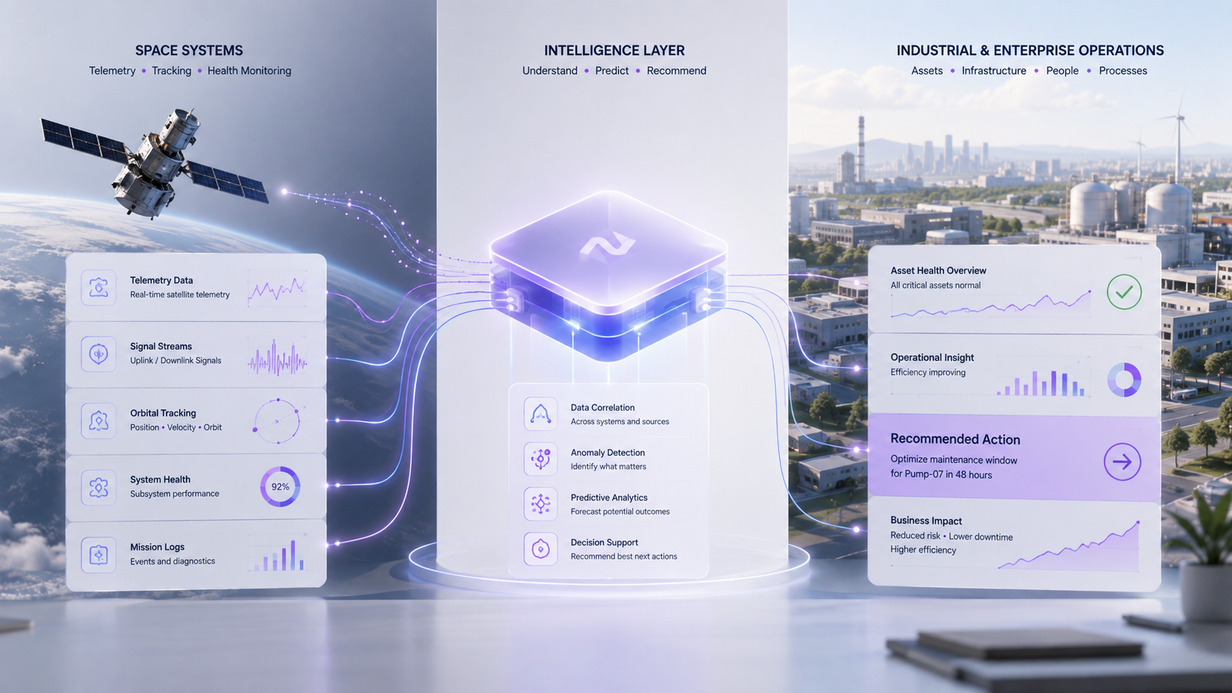
What Space Engineering Teaches Us About Intelligent Systems
Space systems provide a valuable lesson in building reliable technology.
A spacecraft operating in orbit cannot depend on continuous human intervention.
Mission systems must:
- Monitor conditions
- Process telemetry
- Detect anomalies
- Support decisions
- Operate reliably in challenging environments
The same engineering principles apply to complex systems on Earth.
Whether it is a spacecraft, industrial asset or critical infrastructure, the challenge remains similar:
How do we convert large volumes of operational signals into decisions that humans can trust?
This requires engineering the complete system, not just selecting a technology.
Why Digital Transformation Projects Struggle
Many organizations begin transformation by choosing technology first.
They ask:
Should we implement AI?
Should we build a Digital Twin?
Should we add more sensors?
But the first question should be:
Which operational decision needs improvement?
Successful intelligent systems begin with:
- A clear operational problem
- A measurable outcome
- The people responsible for decisions
- The information they require
- The workflow after the decision
Without this foundation, organizations risk creating advanced systems that generate information but do not improve operations.
Engineering Systems People Can Trust
At Neurom Innovations, we do not build isolated technology components.
We engineer intelligent systems that connect:
- Physical assets
- Operational data
- Software platforms
- AI capabilities
- Human decision workflows
The challenge is not only making systems intelligent.
The challenge is making them useful, reliable and trusted in real operational environments.
This requires understanding both sides:
The engineering behind the system.
And the reality where decisions are made.
The Intelligence Layer for Complex Systems
The next generation of operational technology will not be defined by how much data an organization collects.
It will be defined by how effectively that data supports decisions.
The journey is:
Observe → Understand → Predict → Decide → Act
At Neurom Innovations, we engineer intelligent systems that transform complex operational data into actionable decisions.
Because in complex environments, the value of data is not measured by how much information exists.
It is measured by the confidence it creates when action is required.
The real advantage is not having more data. It is knowing what to do with it.
Have a complex operational problem where data exists, but decisions still depend on manual interpretation?
Let’s explore what an intelligent system could look like for your operation.
hello@neurom.in
- Intelligent Systems
- Operational Intelligence
- Decision Intelligence
- Industrial IoT
- Digital Twins