Digital Twins
Why Manufacturing AI Fails in Production: From Pilot to Factory Floor

AI Team - Neurom
October 6, 2026
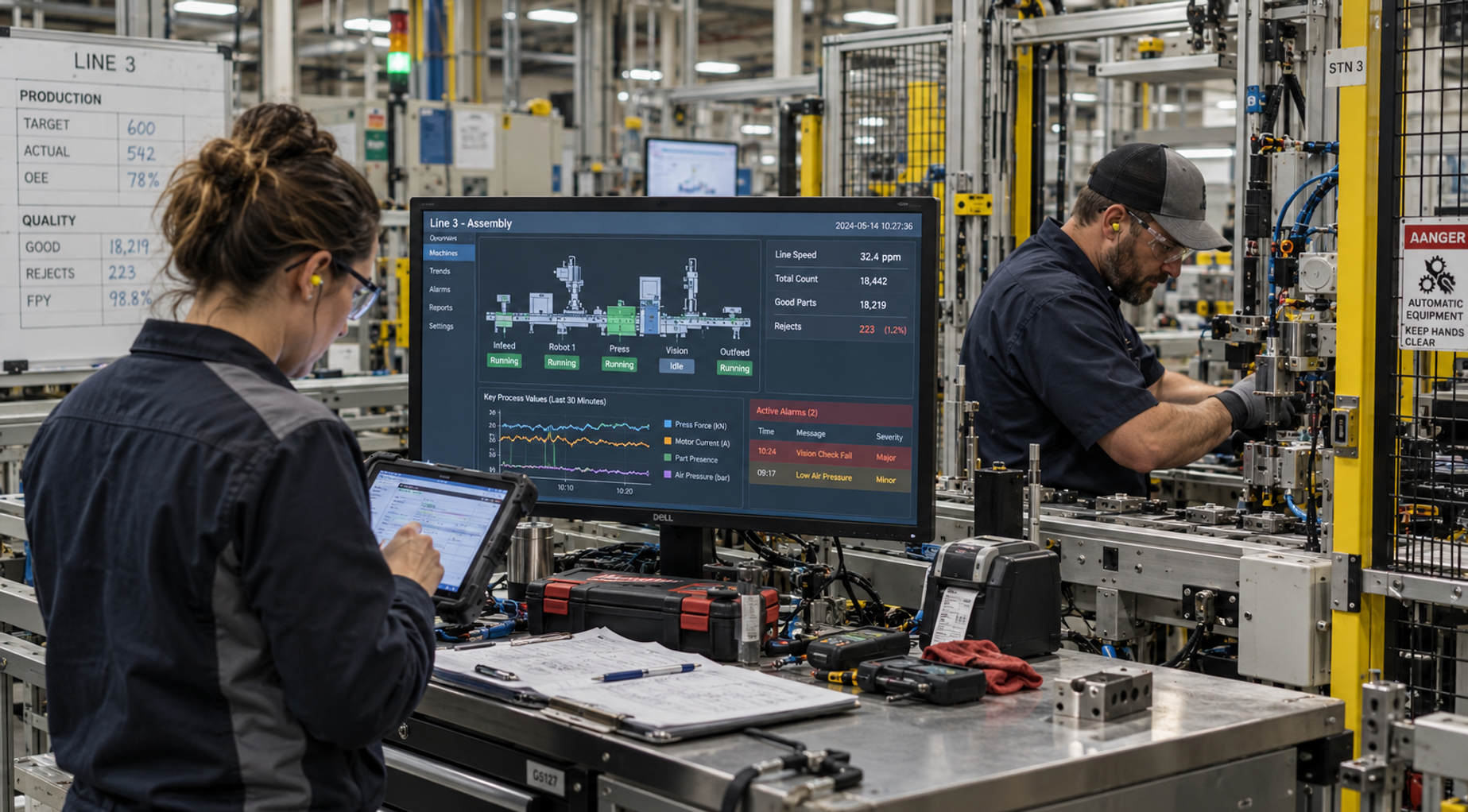
A successful AI model is only the beginning. The harder engineering problem is making it work inside a live manufacturing environment.
Manufacturers are investing in AI for predictive maintenance, quality inspection, production optimization and operational decision-making. The technology is becoming increasingly capable, and AI is already moving beyond experiments into real production environments.
Yet there is a recurring gap between an AI pilot and a production system.
A model can perform well with historical data and still struggle when connected to a live factory. The reason is usually not that the model suddenly stopped working. The environment around it changed.
Real manufacturing systems contain legacy equipment, multiple data sources, changing operating conditions, network and security constraints, existing software and established human workflows. Getting AI to work within all of that is a very different engineering problem from building the original model.
Why does AI fail in manufacturing?
Manufacturing AI rarely fails because the algorithm cannot make a prediction. More often, the surrounding system is not ready to support that prediction reliably.
Consider a manufacturer developing an AI system to predict failures in a critical production asset. During the pilot, the team has historical sensor data, cleans the dataset, trains a model and achieves promising accuracy.
Then the system moves toward production.
Live sensor data arrives at different intervals. A legacy controller uses a different protocol. Maintenance records sit in another system. Operating conditions change between production runs. An experienced maintenance engineer knows that certain readings are normal under specific conditions, but that knowledge may never have been included in the training data.
The model may still be good.
The production system is not ready.
That distinction is central to successful AI deployment in manufacturing.
The factory data problem
Manufacturing companies often hear that AI needs “good data.” That is true, but good industrial data means more than having a clean spreadsheet or a large historical dataset.
A temperature reading, vibration signal or pressure value has meaning only when it is understood in relation to the asset and its operating condition.
A vibration pattern that looks abnormal in isolation may be normal during a particular production cycle. A missing sensor value may be a simple data issue-or evidence that the sensor itself has failed.
This is why industrial AI needs context as well as data.
McKinsey identifies missing data, broken or miscalibrated sensors, incomplete data mappings, incompatible systems and architectural limitations among the common data-quality problems affecting AI in manufacturing.
NIST's 2026 roadmap reaches a similar conclusion, identifying industrial data complexity, data management and integration with heterogeneous sensing and control systems as important barriers to reliable AI adoption in smart manufacturing.
The implication is simple: a better model cannot compensate for missing operational context.
Why is AI deployment difficult in manufacturing?
A factory rarely runs on one software system.
A typical environment can include PLCs and SCADA, MES and ERP platforms, historians, maintenance systems, databases, sensors and newer edge or cloud applications. An AI system has to work with this existing environment rather than assuming it can start from scratch.
Imagine an AI system detecting an abnormal machine condition.
Where does the result go?
If it appears only on a separate dashboard that nobody regularly checks, the prediction has limited operational value. The result may need to reach a maintenance workflow, an operator interface or an existing enterprise system. It may also need to provide enough context for an engineer to decide whether action is actually necessary.
This is why AI integration in manufacturing can be harder than developing the initial model.
The model is one component.
The surrounding system determines whether that component becomes useful.
The production environment keeps changing
Even after deployment, the problem does not disappear.
Machines are replaced. Sensors are recalibrated. Production conditions change. New products are introduced. Processes are modified. Software systems are upgraded.
The data distribution that a model learned from six months ago may no longer represent the factory today.
Production AI therefore needs a lifecycle rather than a one-time handoff. Data quality, model behaviour, system performance and operational outcomes all need to be monitored over time.
NIST's current manufacturing AI work specifically includes evaluating integration effort, performance, semantic correctness and scalability, alongside human-AI collaboration and operator understanding.
That is an important shift in thinking.
Production AI is not a finished model. It is a system that has to remain useful as the operation changes.
The human workflow is part of the system
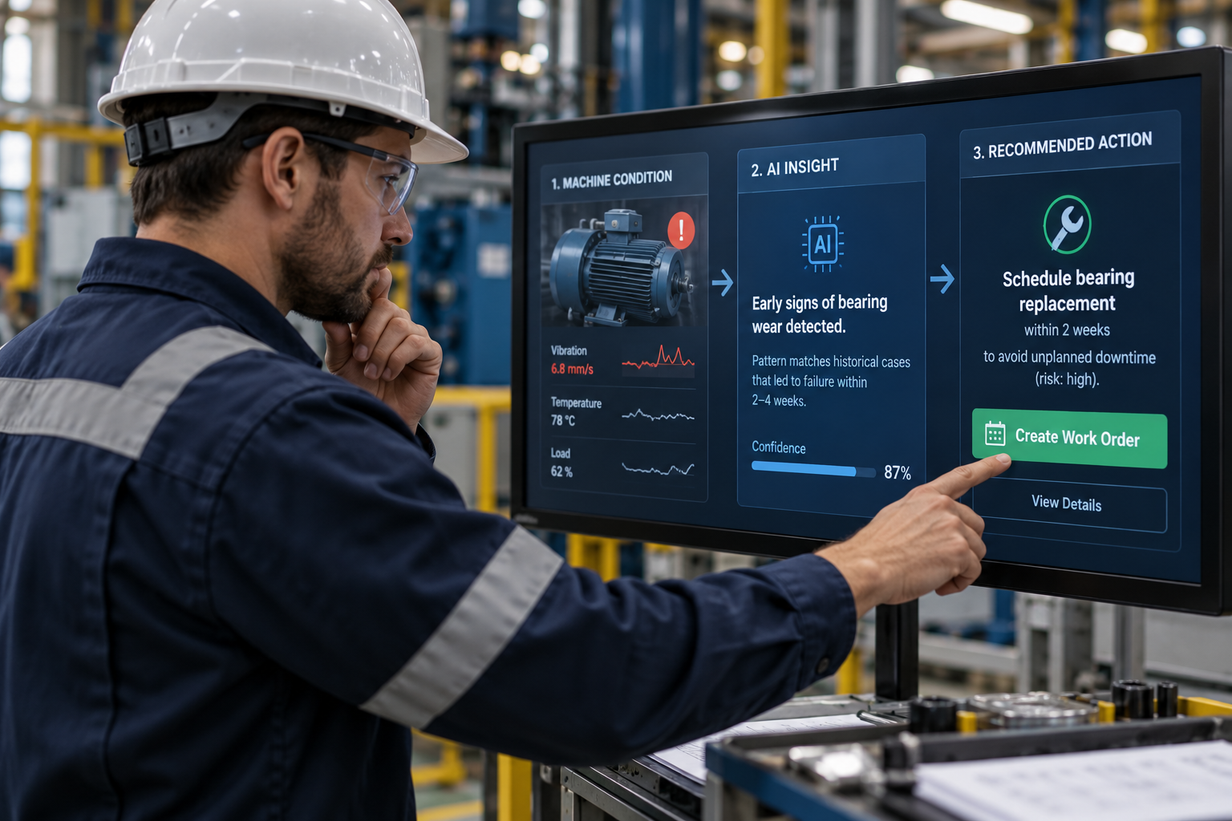
Manufacturing AI providing operational insight for a production decision
There is another reason manufacturing AI projects can struggle: the output has to make sense to the people using it.
An operator may not need another graph. A maintenance engineer may not need a probability score without context. A production manager may need to understand the operational consequence before deciding whether to change a process.
The useful question is not simply:
“Can the AI predict something?”
It is:
“Can the person responsible for the operation use that prediction to make a better decision?”
NIST's manufacturing AI initiative is explicitly examining human-AI teaming, operator understanding and fitness-for-purpose alongside technical integration.
That makes interface design, workflow integration and human validation part of the engineering problem-not an afterthought.
From AI Pilot to Production Requires a Different Approach
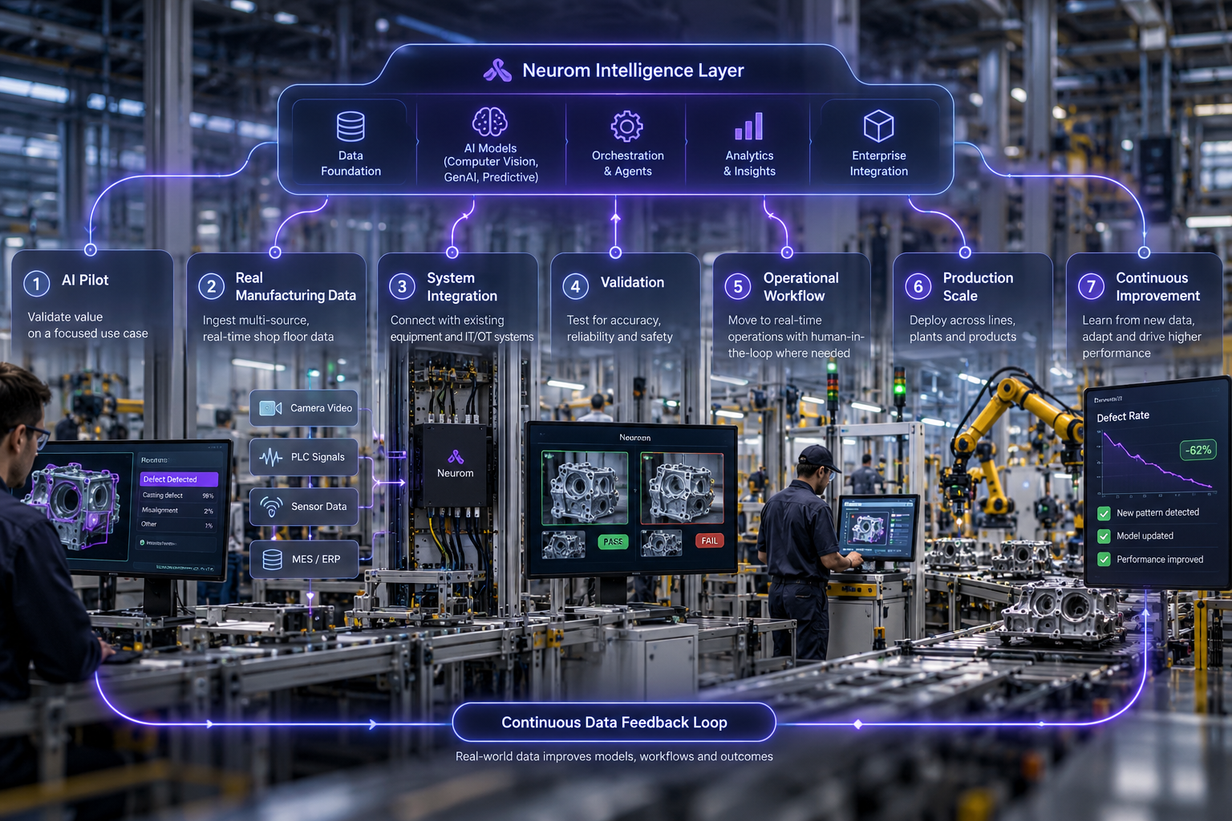
From AI pilot to production: the engineering path for manufacturing AI.
Moving an AI system into production requires several engineering disciplines to work together.
Data engineering makes the required information accessible and reliable. Industrial integration connects the solution with existing equipment and software. AI and analytics provide the intelligence. Application engineering turns the output into something people can use. Operations and domain experts validate whether the result actually makes sense under real conditions.
No single layer solves the problem on its own.
This is why manufacturing AI should increasingly be treated as a systems-engineering problem, not simply an AI project.
Where Forward Deployed Engineering fits
This is where Forward Deployed Engineering in manufacturing becomes particularly relevant.
An FDE works close to the operational environment rather than treating deployment as a final handoff. The engineer can understand the existing systems, identify technical constraints, connect data sources, integrate the solution, validate it with the people who use it and continue improving it after deployment.
For a manufacturer, that could mean connecting an AI model to existing plant data, integrating a Digital Twin with live IoT signals or building decision-support software around an existing production workflow.
The technology depends on the problem.
The engineering approach remains the same: build for the environment in which the system will actually operate.
Neurom's Forward Deployed Engineering approach brings together requirement analysis, system and API integration, development, testing, deployment, troubleshooting and continuous improvement around operational requirements.
What does production-ready manufacturing AI look like?
Production-ready AI is not defined by how impressive a model looks in a demonstration.
It is defined by whether the complete system can operate reliably with real data, real equipment and real people.
That means the system can understand its inputs, work with the existing technical environment, communicate useful information to the people responsible for decisions and continue improving as the operation changes.
This is also where technologies such as Digital Twin solutions and Industrial IoT can become valuable. A Digital Twin can provide operational context around physical assets, while connected data can provide a continuously updated view of what is happening in the real environment.
Neurom's existing work around machine downtime and predictive maintenance explores this broader connection between operational data, connected assets and intelligent maintenance.
The real challenge is not the model
Manufacturing AI does not fail in production simply because the algorithm is weak.
The gap usually appears between the algorithm and the environment around it.
Data needs context. Systems need integration. Predictions need workflows. Models need validation. People need information they can trust and act upon.
The World Economic Forum's recent work on moving AI from pilot to production reflects the same shift: AI is increasingly being embedded into physical environments such as factories, with operational deployment and human oversight becoming central to successful implementation.
The next step for manufacturing AI is therefore not simply building better models.
It is engineering the complete path from signal to decision.
And that is where the real value of industrial AI begins.
Frequently Asked Questions
Why does AI fail in manufacturing?
AI projects can struggle when data quality is inconsistent, industrial systems are difficult to integrate, operating conditions change, or the AI output does not fit the workflow of the people using it. The challenge is usually the complete production system rather than the model alone.
Why is AI deployment difficult in manufacturing?
Manufacturing environments combine legacy equipment, PLCs, SCADA, MES, ERP, sensors and other systems that were often developed at different times. Connecting AI reliably to these systems while maintaining security, performance and operational continuity makes deployment more complex than a controlled pilot.
How do you move AI from pilot to production in manufacturing?
The transition requires reliable operational data, integration with existing systems, validation under real conditions and a workflow that allows people to act on the output. Production systems also need monitoring and continuous improvement as equipment and operating conditions change.
What is the role of Forward Deployed Engineering in manufacturing AI?
Forward Deployed Engineering helps close the gap between an AI solution and the environment where it needs to operate. FDEs work with operational and engineering teams to understand constraints, integrate systems, deploy solutions and improve them using real-world feedback. Read more about Forward Deployed Engineering in manufacturing.
Does manufacturing AI require Digital Twins?
Not every use case needs a Digital Twin. They become particularly useful when understanding the state, relationships or behaviour of physical assets is important to the decision being supported. Combined with IoT, analytics and AI, a Digital Twin can provide additional operational context.
Have an AI pilot that needs to work in the real production environment?
- Forward Deployed Engineering
- Manufacturing AI
- Industrial AI
- Digital Twin
- Industrial IoT
- Operational Intelligence