Digital Twins
Digital Twin vs Digital Model: What Actually Makes a Digital Twin Useful?

Aze Zunnisa
October 17, 2026
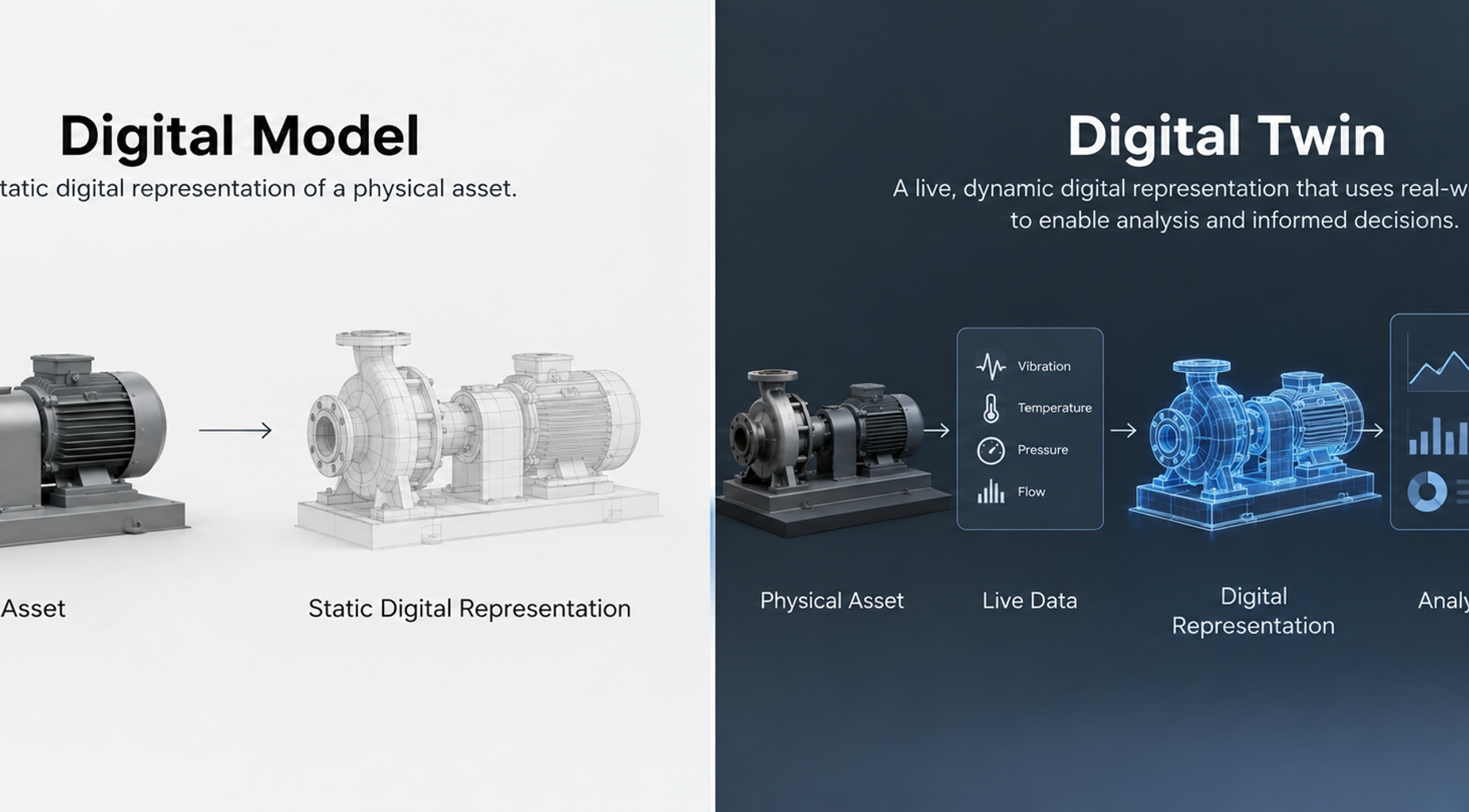
A 3D model can look exactly like a machine, factory or facility.
That does not automatically make it a Digital Twin
The distinction matters because organizations are investing in increasingly detailed digital representations of physical assets, while the real value of a Digital Twin comes from something beyond visual accuracy: its ability to stay connected to the real system, understand its state and support decisions.
A useful way to think about it is simple:
A digital model represents something. A Digital Twin stays connected to the thing it represents.
That connection changes what the digital representation can actually do.
What is a digital model?
A digital model is a digital representation of a physical object, system or process.
It could be a CAD model of a machine, a 3D representation of a factory, a mathematical model of a process or a simulation used to evaluate different scenarios.
Digital models are extremely useful. Engineers use them for design, visualization, simulation, planning and documentation.
But a model can exist independently from the physical system.
A 3D model of a production line, for example, may accurately represent the layout, equipment and geometry of the factory. If a machine is moved tomorrow, however, the digital model will not know unless someone updates it.
That is where the distinction begins.
So, what makes a Digital Twin different?
A Digital Twin connects the digital representation to the real-world entity or process it represents.
The Digital Twin Consortium defines a Digital Twin as a virtual representation of real-world entities and processes that is synchronized at a specified frequency and fidelity. It also describes Digital Twins as systems that use real-time and historical data to represent past and present states and support simulation of possible futures.
In practical terms, that means the digital representation is not simply sitting there as a static copy.
It receives information.
It reflects changes.
It can provide context.
And depending on the use case, it can help evaluate what could happen next.
NIST similarly describes Digital Twins as computer models of physical systems that can support monitoring, prediction, optimization and decision-making, particularly in manufacturing.
That is the difference between looking at a digital representation and using one to understand an operating system.
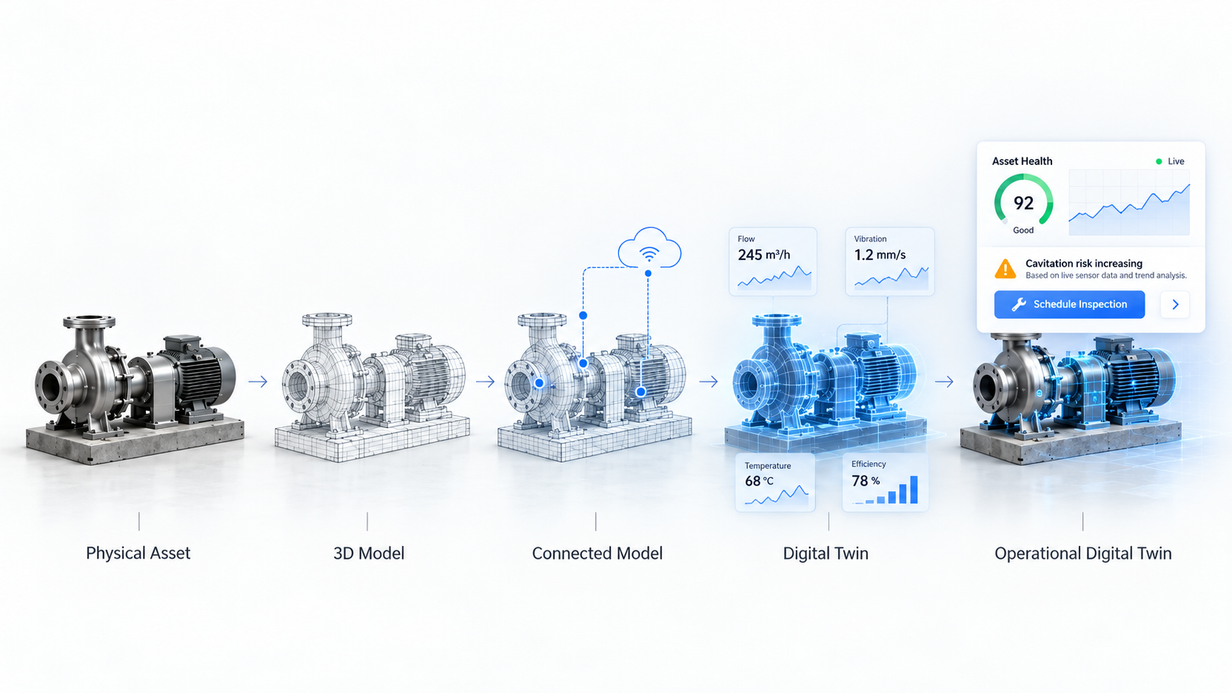
A 3D model is useful. It just isn't the whole twin.
This distinction is particularly important as 3D visualization becomes more sophisticated.
A photorealistic 3D environment can reproduce a physical location with remarkable detail. Technologies such as 3D Gaussian Splatting can make digital environments feel almost indistinguishable from the captured physical space.
But visual fidelity and operational intelligence are different things.
Neurom's work with 3D Gaussian Splatting explores how photorealistic spatial environments can become part of real-time Digital Twin experiences when connected with IoT data, interactive assets and operational information.
The 3D environment provides the spatial layer.
The data and synchronization provide the operational layer.
The intelligence built on top of both is what can make the system useful.
What does a Digital Twin actually need?
There is no single technology stack that defines every Digital Twin.
A manufacturing Digital Twin might contain a 3D environment. Another might be primarily data and simulation. A third might focus on a single machine rather than an entire facility.
What matters is whether the architecture is appropriate for the problem.
At a practical level, a useful Digital Twin often brings together several elements:
The physical system provides the thing being represented.
Data sources provide observations from sensors, equipment, databases and operational systems.
The digital representation provides the model of the asset, process or environment.
Context explains what the data means in relation to the asset and its operating condition.
Analytics and simulation help identify patterns, test scenarios or predict possible outcomes.
The operational interface gives engineers and decision-makers a way to understand what is happening and decide what to do next.
The exact combination depends on the use case.
NIST's manufacturing Digital Twin work emphasizes this same systems approach, including data management, model development and validation, integration, interoperability and actionable recommendations.
When does a Digital Model become a Digital Twin?
There is no single checkbox that turns a model into a twin.
But synchronization is one of the clearest dividing lines.
Consider a production machine.
A CAD model can show its dimensions, components and geometry.
Add historical maintenance records, and you have more information.
Add live temperature, vibration and operating data, and the representation begins to reflect the current condition of the machine.
Add analytics that identify abnormal behaviour.
Add simulation that evaluates possible operating conditions.
Add workflows that help a maintenance engineer decide what to do.
Now the digital representation is doing much more than describing the machine.
It is becoming part of an operational system.
The Digital Twin Consortium specifically emphasizes synchronization between the virtual representation and the real-world entity, while ISO 23247 provides a reference framework for Digital Twins in manufacturing.
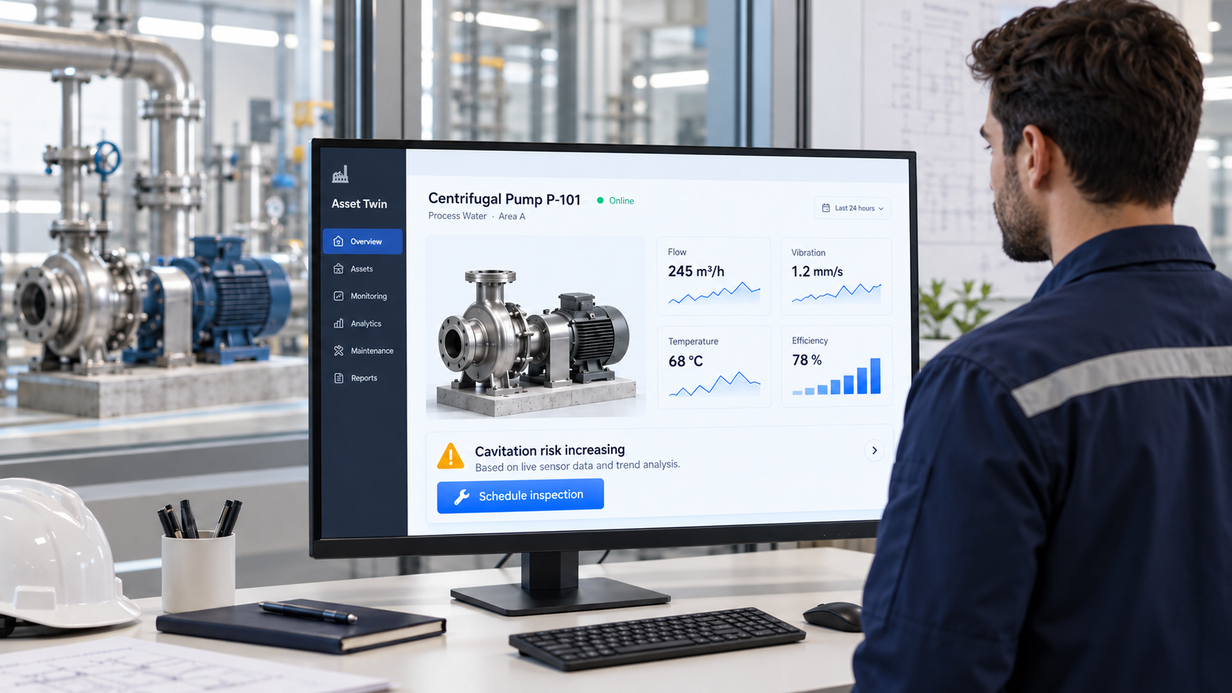
Why synchronization matters
Imagine a Digital Twin of a production line.
At 9:00 AM, the system shows that a motor is operating normally.
At 10:15 AM, vibration increases.
The Digital Twin receives the updated signal and places it in context with operating conditions, historical behaviour and maintenance information.
The system may then identify an emerging anomaly.
The important part is not that the Digital Twin contains a picture of the motor.
It is that the digital representation has changed because the real system changed.
That is what makes synchronization valuable.
The frequency and fidelity of that synchronization should depend on the use case. A building energy model does not necessarily require the same update rate as a high-speed manufacturing process.
The right question is therefore not:
“How real-time is the Digital Twin?”
It is:
“How much synchronization does this decision actually require?”
Does every Digital Twin need 3D?
No.
This is one of the most common misconceptions.
A Digital Twin can exist without a detailed 3D environment.
If the objective is monitoring the health of a pump, for example, a data-driven interface may be enough. If the objective is understanding the spatial relationship between assets inside a facility, 3D visualization becomes much more valuable.
Neurom's own Digital Twin approach reflects this distinction. Its solutions combine operational data, system models and visualization according to the use case, with capabilities including real-time performance visualization, historical and live data analysis, predictive analytics and simulation.
The technology should follow the decision that needs to be supported.
Not the other way around.
What makes a Digital Twin useful in manufacturing?
The value of a Digital Twin appears when it helps answer questions that are difficult to answer from disconnected systems.
For example:
What is happening to this asset right now?
Why is its behaviour changing?
What could happen if the current condition continues?
What happens if we change the operating parameters?
Which maintenance action should be considered?
What would happen if we change the production plan?
These questions require more than visualization.
They require data, context, models, analytics and an understanding of the operational environment.
That is why manufacturing Digital Twins are increasingly being treated as integrated systems rather than isolated 3D applications. NIST's work on manufacturing Digital Twins specifically addresses integration, interoperability, validation and trustworthy implementation, while ISO 23247 provides a manufacturing reference framework.
A Digital Twin should support a decision
This is perhaps the most useful test.
Take away the 3D visualization for a moment.
What decision does the Digital Twin help someone make?
If the answer is clear, the technology has a purpose.
If the answer is simply:
“It lets us see the factory in 3D.”
then you may have built a valuable visualization system, but you may not yet have built a Digital Twin that delivers operational value.
A useful Digital Twin should connect the physical world to information that helps someone understand, predict, optimize or act.
That might happen through a dashboard.
It might happen through a simulation.
It might happen through an immersive environment.
It might happen through AI-assisted recommendations.
The interface is secondary.
The decision is the point.
The architecture should start with the problem
There is a temptation to begin a Digital Twin project by choosing the visualization technology, simulation platform or 3D engine.
That can be backwards.
Start with the operational question.
If the goal is predictive maintenance, the architecture may prioritize asset data, sensor signals, historical behaviour and predictive analytics.
If the goal is facility operations, spatial context and real-time asset status may matter more.
If the goal is simulation, physics-based models and scenario analysis may become central.
If the goal is training, an immersive environment may provide the greatest value.
The Digital Twin should be designed around the decision it needs to support.
From Digital Representation to Digital Intelligence
The evolution is not really:
2D → 3D → Digital Twin
It is closer to:
Representation → Connection → Context → Intelligence → Action
A 3D model can be the foundation.
IoT can provide the connection.
Operational data provides the changing state.
Analytics and AI provide interpretation.
Simulation can explore what happens next.
And the final layer connects that understanding to a human or automated decision.
That is where a Digital Twin becomes more than a digital copy.
It becomes an operational system.
The real test
The easiest way to evaluate a Digital Twin is to stop asking how realistic it looks.
Ask what it knows.
Ask how that information stays connected to the real system.
Ask what it can predict or simulate.
And most importantly, ask:
What better decision can someone make because this Digital Twin exists?
If there is no clear answer, adding more polygons, more dashboards or more visual effects will not solve the problem.
A useful Digital Twin is not defined by how impressive the digital representation looks.
It is defined by how effectively it connects the real world, operational data and engineering intelligence.
That is the difference between a digital model that represents an asset and a Digital Twin that helps you understand and operate it.
Frequently Asked Questions
What is the difference between a Digital Twin and a digital model?
A digital model is a representation of a physical object, system or process. It can be used for design, simulation or visualization without being connected to the live physical system. A Digital Twin adds synchronization with the real-world entity and can use operational data to represent current conditions and support analysis or decisions.
Is a 3D model a Digital Twin?
Not necessarily. A 3D model primarily represents the physical appearance or structure of something. It can become part of a Digital Twin, but a Digital Twin typically also requires an appropriate connection to real-world data, synchronization, context and a defined operational purpose.
Does a Digital Twin need real-time data?
Not always. The required synchronization frequency depends on the use case. Some applications may require near-real-time data, while others can work with periodic or historical updates. The appropriate level of synchronization should be determined by the decisions the Digital Twin needs to support.
Can a Digital Twin exist without 3D?
Yes. A Digital Twin does not have to include a detailed 3D environment. It can focus on operational data, asset state, simulation, analytics or workflows. 3D becomes valuable when spatial relationships and visual context are important to the use case.
What makes a Digital Twin useful in manufacturing?
A useful manufacturing Digital Twin connects the right physical and operational data with models, analytics and workflows to help teams understand current conditions, identify issues, evaluate possible outcomes and make better decisions. Manufacturing frameworks such as ISO 23247 address the architecture and information requirements needed to support these kinds of applications.
When should a company build a Digital Twin?
A Digital Twin makes sense when understanding the state, behaviour or future possibilities of a physical asset, process or environment can improve a meaningful operational decision. The project should start with that decision rather than with a particular 3D or software technology.
Is your Digital Twin showing the asset-or helping you understand it?
hello@neurom.in
- Digital Twin vs Digital Model
- digital twin vs 3D model
- real-time digital twin
- digital twin in manufacturing