Digital Twins
Beyond the Mesh: How 3D Gaussian Splatting is Rewriting the Rules of Digital Twins

Aze Zunnisa
June 17, 2026
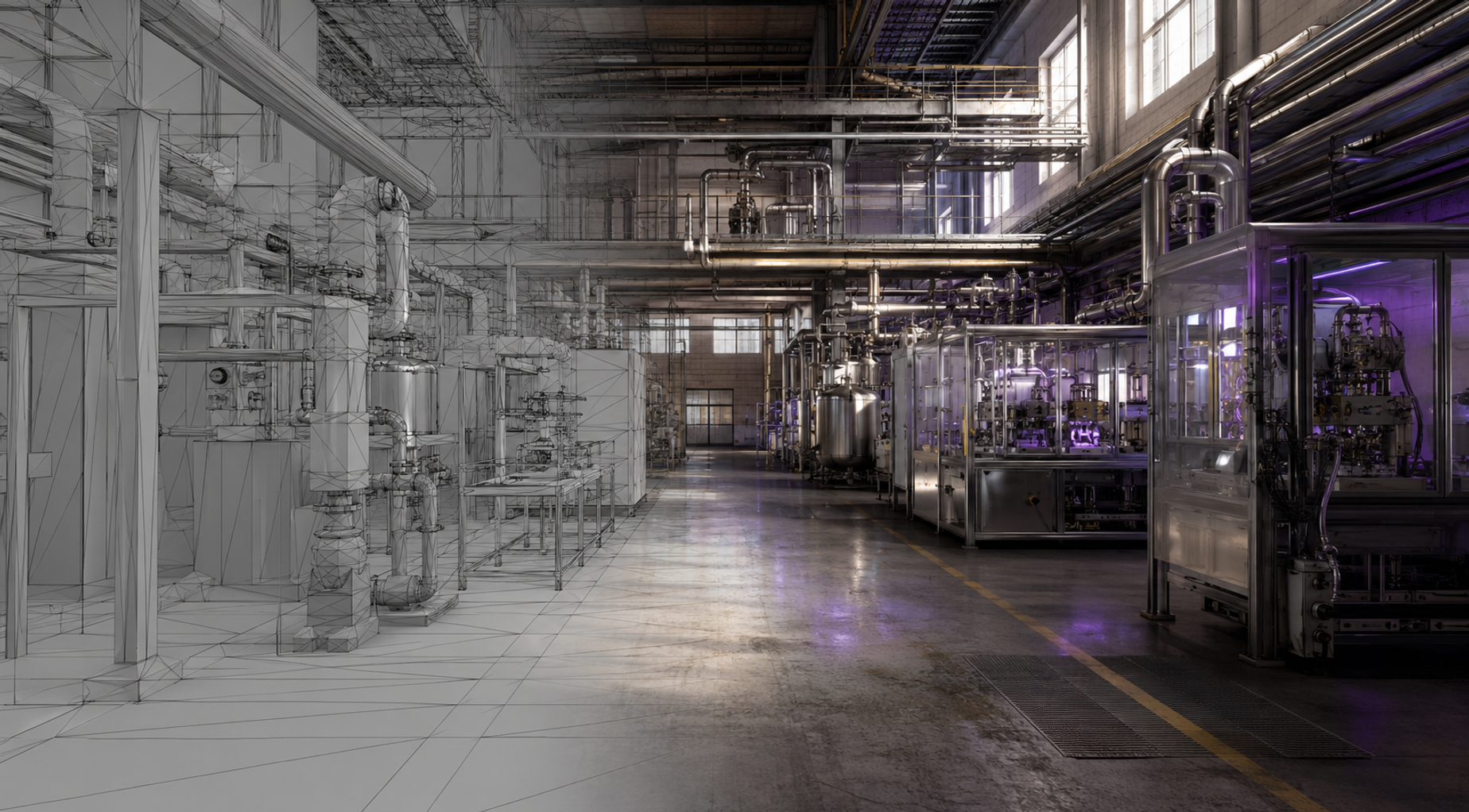
Imagine walking through a massive manufacturing plant, a high-density server room, or a complex infrastructure site. Now, imagine having a digital replica of that exact location running right on your smartphone or laptop. It doesn’t look like a cartoon, a clunky video game, or a jagged CAD drawing-it looks exactly like a high-definition movie. You can see the dust on the pipes, the precise metallic reflections on the machinery, and the glare of the overhead lights. We often receive client requirements asking us to replicate an entire plant, its machinery, or Standard Operating Procedures (SOPs) in a digital format. Traditionally, industry-standard methods involve using laser scanners, LiDAR, or photo and video references to manually build heavy CAD files-typically in .fbx, .obj, or .gltf formats.
But a massive shift is happening. This is the power of 3D Gaussian Splatting (3DGS). It is currently the single biggest disruption happening in spatial computing, and it is completely changing how we build, deploy, and interact with Digital Twins.
What exactly is 3D Gaussian Splatting?
To understand why this is a quantum leap, we have to look at how we used to build virtual replicas. Traditionally, 3D models rely on polygons-rigid, flat triangles stitched together like a digital wireframe statue. When you try to capture highly complex real-world environments using standard photogrammetry, the output is often messy. Edges look melted, complex structures like wires or fences get distorted, and the textures look flat and robotic.
3D Gaussian Splatting completely flips this approach.
Instead of building a scene out of rigid geometric blocks, imagine painting an entire environment using millions of tiny, fuzzy, semi-transparent aerosol spray paint dots-called Gaussians.
Every single individual "splat" (a cloud-like ellipse particle) holds four critical pieces of data:
- Position $(x, y, z)$: Its exact location in 3D space.
- Scale & Rotation: How that tiny cloud stretches or tilts to match real-world shapes.
- Opacity: How transparent it is (which allows it to capture complex elements like glass windows, steam, or fine hair perfectly).
- Color (Spherical Harmonics): This is the magic trick. The color of the splat isn't static; it changes dynamically depending on your viewing angle. Mirror reflections, metallic shine, and shifting shadows look exactly as they do in the physical world, rendered perfectly on your digital screen.
Real-World Impact: Traditional Mesh vs. 3DGS
Industrial environments move fast, and they cannot afford heavy, unoptimized software. Here is how 3DGS completely leaves legacy 3D mapping methods behind:
Feature
Legacy CAD / Photogrammetry
3D Gaussian Splatting (3DGS)
Visual Quality
Surfaces look flat; glass, metallic sheen, and fine details distort or melt.
Ultra-photorealistic. Captures real-world lighting, dynamic reflections, and micro-details flawlessly.
Render Performance
Heavy data freezing on normal devices; requires expensive, high-end gaming GPUs.
Blazing Fast. Easily runs at 100+ Frames Per Second (FPS) directly inside standard web browsers via WebGPU.
Turnaround Time
Days or weeks of manual cleanup, retopology, and optimizing by 3D artists.
Minutes to hours. Drone flights or smartphone videos process rapidly into an operational 3D scene.
How Do We Use 3DGS in Real-Time Digital Twins?
A digital twin cannot just be a pretty 3D model; it must connect seamlessly with real-time operational data. 3DGS makes this incredibly easy because the entire photorealistic scene maps perfectly to exact spatial coordinates.
Here is how it is practically deployed in real-time enterprise ecosystems:
- 1. Live IoT & Sensor Interactivity (Hotspots):Because the 3DGS environment is spatially accurate, you can anchor invisible, interactive data points directly onto physical objects within the splat. Clicking on a photorealistic pump, circuit breaker, or server rack inside a web dashboard instantly pulls up live pressure graphs, temperature analytics, or error logs fetched directly from the cloud database.
- 2. Modular Updates (No Downtime):Physical workspaces change constantly. If a factory floor installs a new piece of machinery, you don't need to re-model or re-render the entire facility. Operations teams can simply capture a quick smartphone or drone scan of that specific zone and "patch" the new splat data directly into the master twin environment without breaking the system.
- 3. Simulation & Remote Edge Control: For remote operations and maintenance, 3DGS provides an unprecedented level of situational awareness. Whether training operators remotely, mapping paths for autonomous warehouse robots, or troubleshooting a breakdown from across the world, teams interact with a zero-latency, true-to-life replica of the asset.
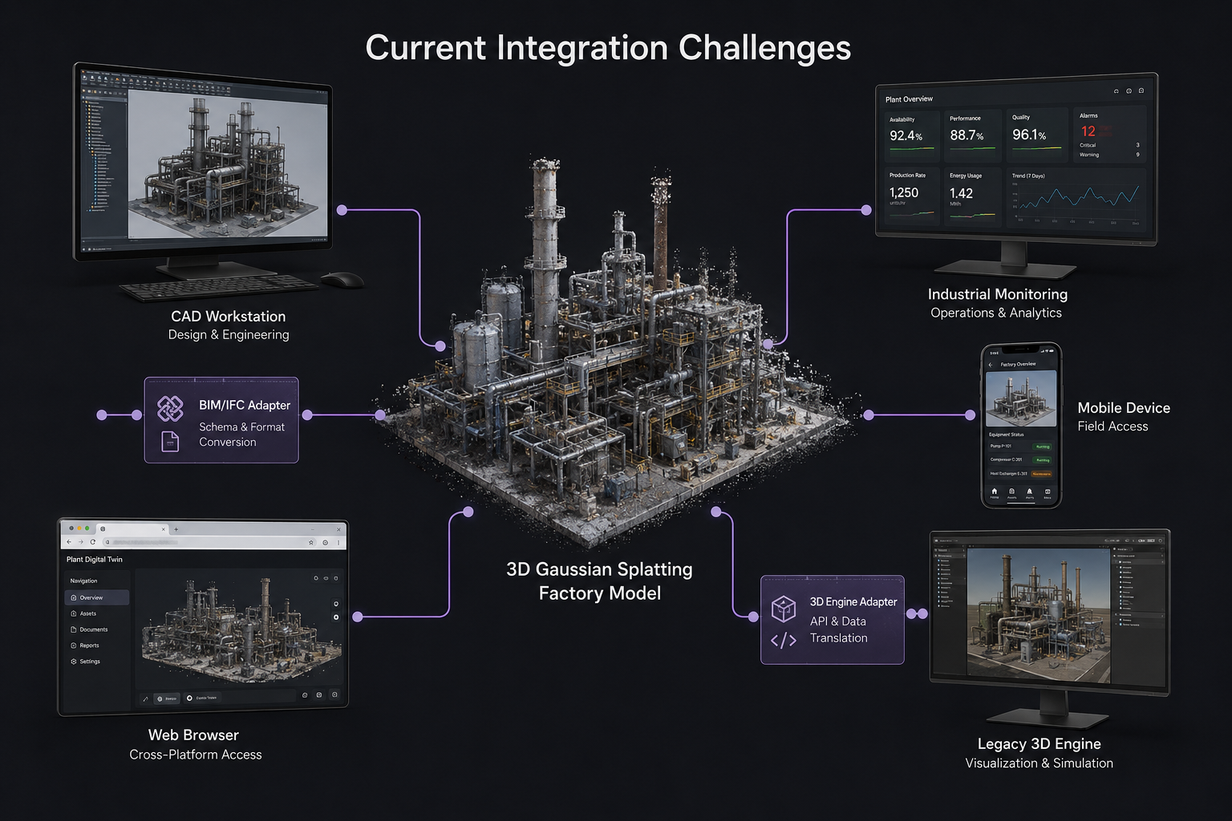
Current Challenges in Development
While 3DGS is a massive leap forward, we have observed a few real-world drawbacks during the development of digital twins:
- Tool Adaptability: 3D Gaussian formats are still relatively new and are not yet universally accepted across all legacy 3D engines and traditional industrial tools.
- Cross-Platform Integration: Although cross-platform adaptability is progressing steadily day by day, seamlessly embedding these files into existing enterprise pipelines still requires some custom workarounds.
The Takeaway
The bottleneck of heavy, expensive, and slow 3D modeling is officially broken. By moving away from rigid graphics pipelines and embracing the speed and photorealism of 3D Gaussian Splatting, industries can now deploy weightless, browser-based digital twins that run on any device, anywhere.
The future of real-time monitoring isn’t flat dashboards or boxy layouts anymore-it is true spatial reality.
What's your take?
Is your organization still relying on legacy, static CAD layouts for asset management, or are you ready to transition to high-speed spatial computing? Let's discuss in the comments below!
- Spatial Computing
- Digital Twins
- 3DGS
- Real-Time Rendering
- Industrial IoT