Digital Twins
Small Language Models on the Shop Floor: Why Industrial Edge AI Is Finally Leaving the Cloud Behind

Aze Zunnisa
November 23, 2026
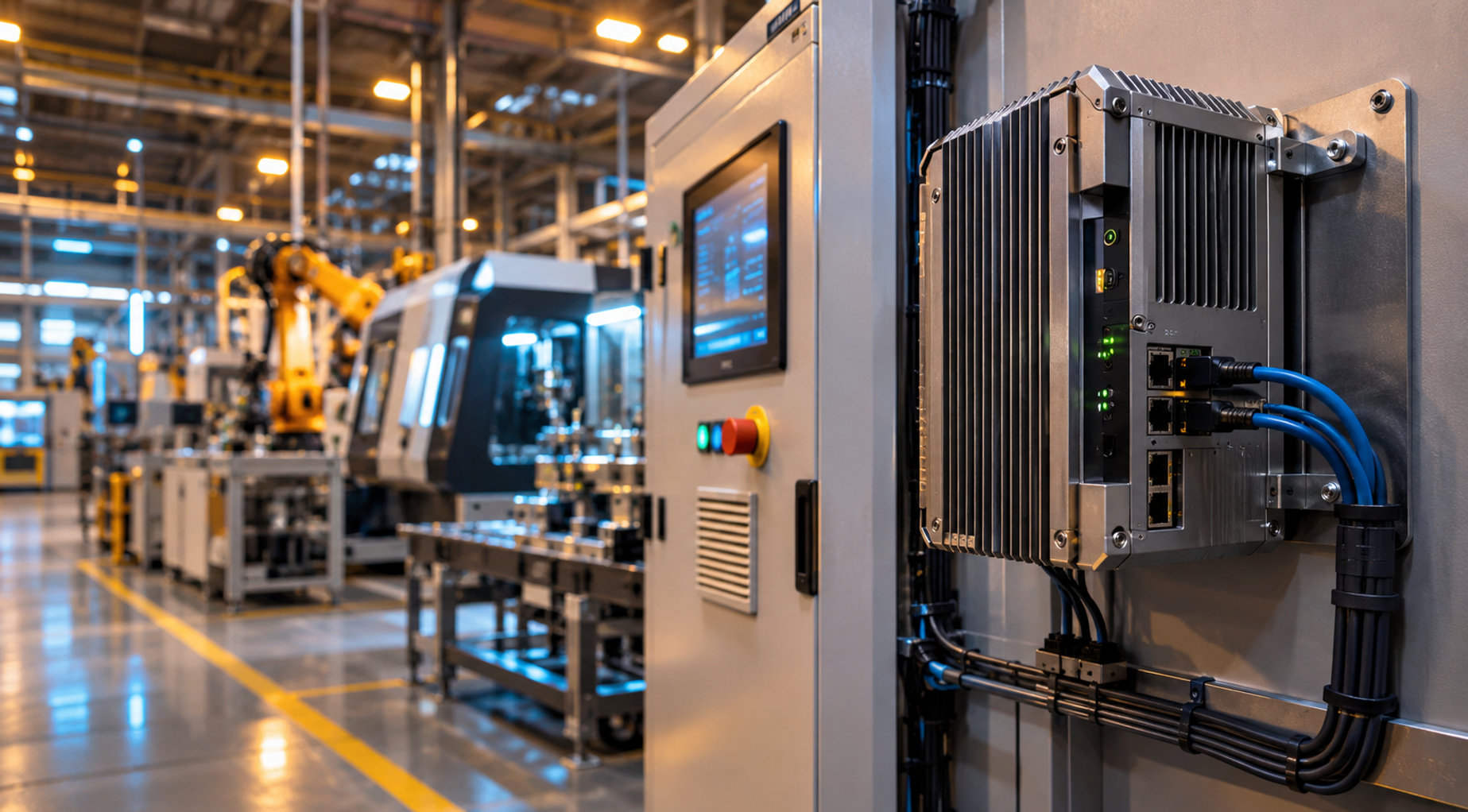
For the past three years, industrial AI followed a predictable-and largely broken-playbook: stream massive volumes of factory telemetry to the public cloud, run it through a general-purpose Large Language Model (LLM), and wait for insights to trickle back to the shop floor.
In November 2026, that era officially hit its inflection point. Earlier this month,Rockwell Automation expanded its industrial edge computing portfolio with NVIDIA GPUs, unveiling ruggedized industrial PCs built specifically to run machine vision, predictive maintenance, and Small Language Models (SLMs) directly next to the production line. Around the same time, Schneider Electric and BCG partnered to accelerate AI-led smart manufacturing in India-starting right in Hyderabad’s Industry 4.0 Lighthouse Factory.
The hardware has finally caught up to the ambition.Now comes the hard part.
Buying a GPU-accelerated edge box is the easy step. Integrating it into a brownfield plant running 15-year-old mixed-vendor PLCs, legacy SCADA historians, and strict air-gapped networks is where most industrial AI initiatives stall.
Why Cloud-First AI Failed the Factory Floor
Generic tech blogs love to say AI is moving to the edge for "lower latency and better privacy." On an actual shop floor, the reasons are far more concrete-and expensive:
- Connectivity Drops Break Cloud AI: A manufacturing line, pharma cleanroom, or oil & gas facility does not stop when the internet blips. Cloud-dependent AI systems fail precisely when operators need them most.
- Data Sovereignty and Regulatory Risk: Regulated Indian pharmaceutical, defence, and aerospace plants cannot stream proprietary Standard Operating Procedures (SOPs), batch records, or raw operational telemetry to third-party cloud APIs.
- Egress and Token Economics: Streaming high-frequency vibration, thermal, or high-definition vision data to the cloud 24/7 destroys unit economics before a pilot ever scales to a second facility.
What Actually Changes When Intelligence Runs at the Edge
Moving AI from the cloud to the shop floor is not just a hosting decision-it fundamentally changes how industrial software must be architected.
1. From Massive LLMs to Task-Specific SLMs
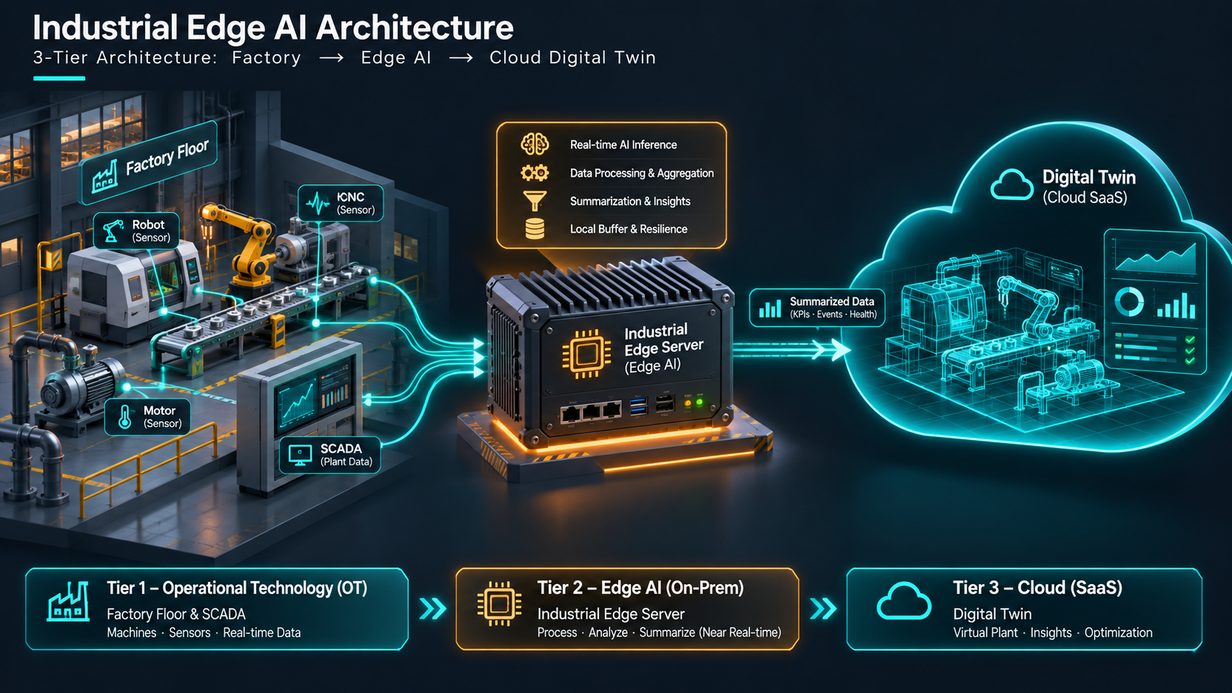
A plant technician troubleshooting a boiler pressure drop does not need a 400-billion-parameter model that can write poetry. They need a quantized Small Language Model (SLM) running locally on an industrial edge node. Local SLMs deliver sub-second responses, operate completely offline, and can be tightly grounded in your plant’s exact equipment manuals, maintenance logs, and SOPs.
2. Read-Only Intelligence First, Bounded Action Second
Experienced OT engineers are right to be skeptical of letting an autonomous agent write directly to a live PLC or SCADA control loop. Mature Agentic AI deployments start as a read-only diagnostic layer: correlating SCADA alarms, flagging subtle anomalies, and surfacing step-by-step SOPs for human operators. Only after the system proves reliability do teams introduce bounded, human-in-the-loop (HITL) workflows.
3. Hybrid Edge-to-Digital-Twin Syncing
Edge AI does not make the cloud obsolete-it changes its job. Real-time inference, anomaly detection, and operator guidance happen locally at the edge. Summarized telemetry and exception events are then synced asynchronously to a Digital Twin in the cloud or central data center for fleet-wide simulation, root-cause modeling, and model retraining.
The Missing Piece: Forward Deployed Engineering
Hardware vendors sell edge boxes. Cloud providers sell APIs. Neither sits on your shop floor mapping inconsistent Modbus and OPC UA tags, cleaning noisy sensor streams, or designing interfaces that shift operators actually trust.
That integration gap is why so many Industry 4.0 pilots stay trapped in "pilot purgatory."
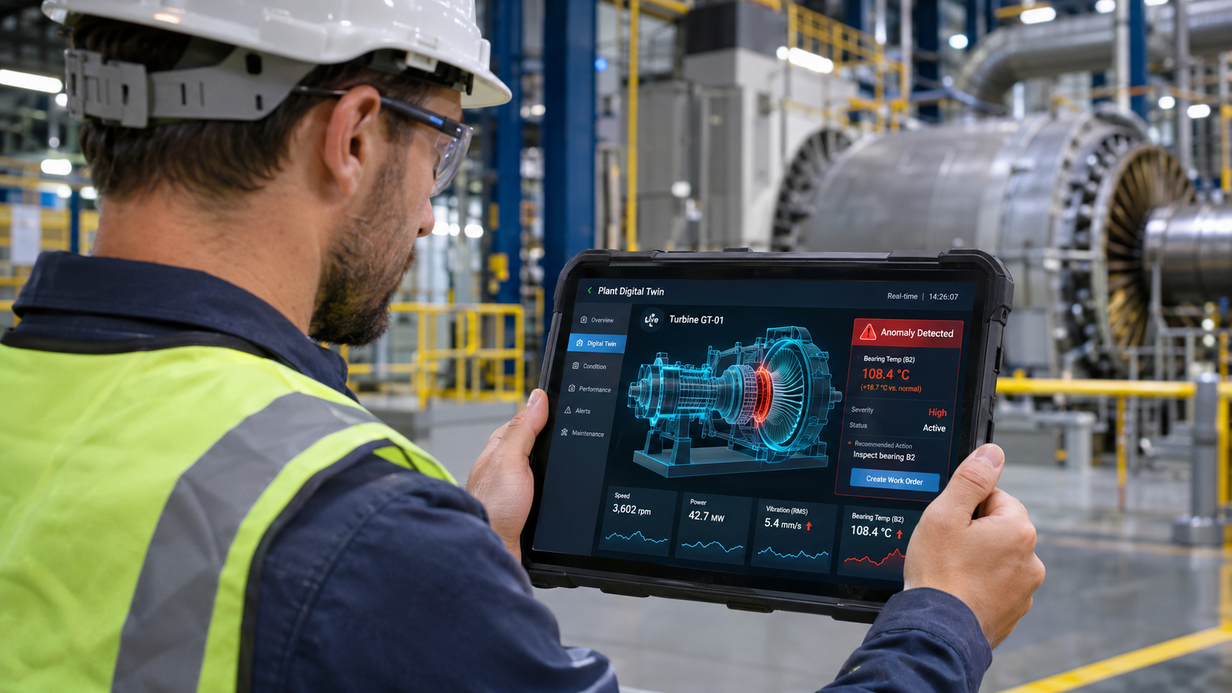
At Neurom Innovations, we solve this through Forward Deployed Engineering (FDE). Instead of handing over a slide deck or a generic software license, our engineers embed directly alongside your plant and OT teams. We connect legacy Industrial IoT and SCADA infrastructure, deploy quantized SLMs and vision models onto edge hardware, and bridge them cleanly into real-time Digital Twins-shipping production-grade systems in weeks rather than 18-month consulting cycles.
Ready to Move Beyond the Cloud?
The shift to Industrial Edge AI is no longer a future trend-it is happening on factory floors right now. If your team is evaluating how to bring AI to legacy SCADA environments without compromising plant safety or data sovereignty, get in touch with Neurom’s Forward Deployed Engineering team for an architecture readiness audit.
hello@neurom.in
- Industrial Edge AI
- Small Language Models (SLMs)
- Industrial IoT
- SCADA Modernization
- Digital Twins
- Forward Deployed Engineering