IoT
Digital Twins in Maritime: How IoT Is Helping Ships Burn Less Fuel and Make Smarter Decisions

Aze Zunnisa
June 11, 2026
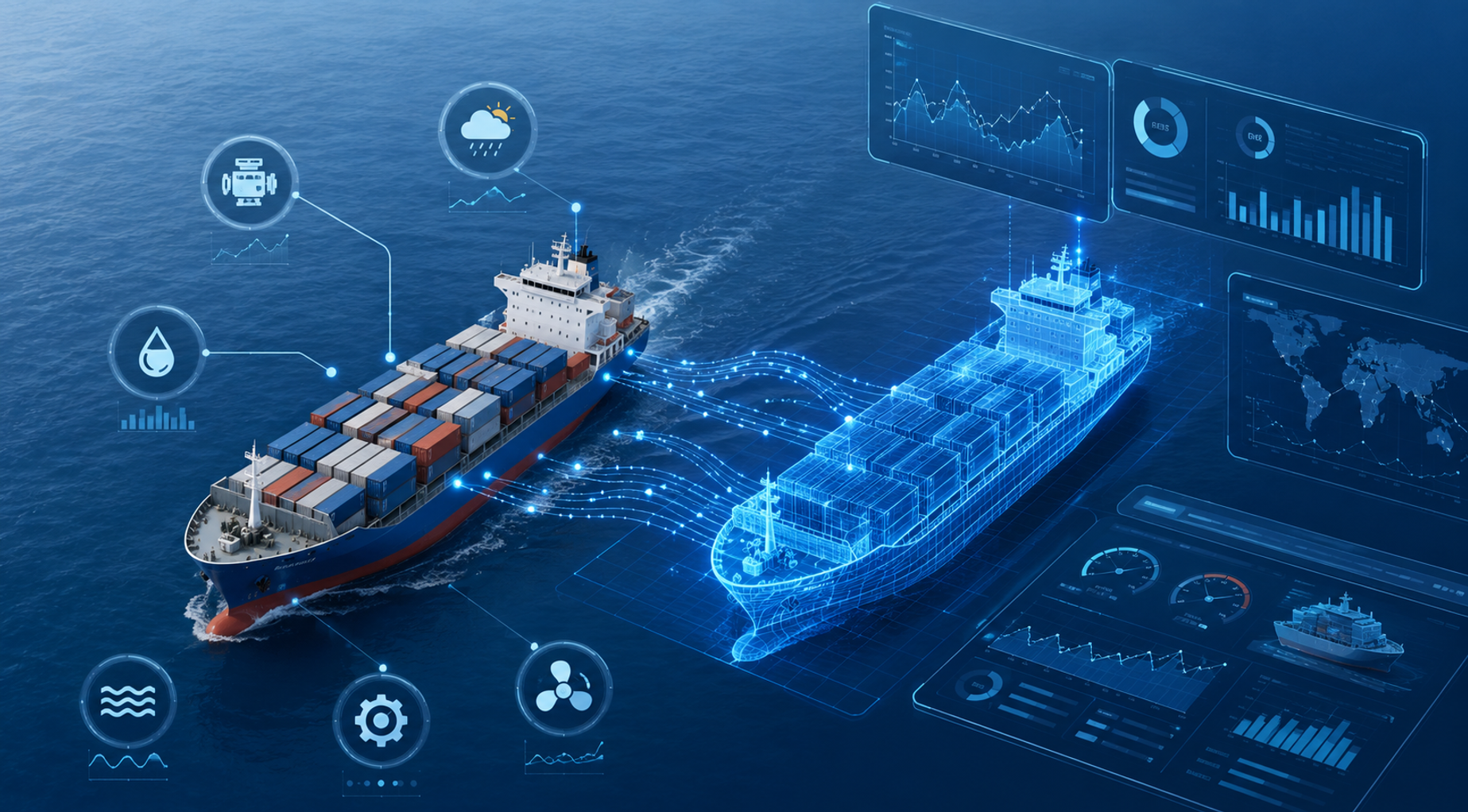
Every day, shipping companies make hundreds of operational decisions that impact fuel consumption, vessel performance, and profitability. A small change in speed, route selection, weather response, or engine performance can create significant differences in operating costs across an entire fleet.
Yet many maritime organizations still rely on historical reports to understand vessel performance. By the time inefficiencies are identified, the fuel has already been consumed.
The challenge in modern shipping is not the lack of data. It is transforming operational data into decisions that improve efficiency.
This is where Digital Twins and IoT are changing maritime operations.
Maritime transport moves more than 80% of global goods, making it a critical part of the global economy. At the same time, fuel remains one of the largest controllable expenses for vessel operators. Even small improvements in efficiency can create significant savings across fleets.
Through our work in Digital Twins, IoT, and operational intelligence, we've observed that most organizations don't struggle with data availability. They struggle with transforming that data into actions that improve efficiency and performance.
This is where Digital Twins and IoT are beginning to create measurable impact.
Shipping's Biggest Cost Isn't the Vessel. It's the Fuel.
For many operators, fuel remains the single largest controllable expense.
A vessel consuming just a few percentage points more fuel than necessary may not raise immediate concerns. Across dozens of vessels and hundreds of voyages, however, those inefficiencies add up quickly.
Studies across the shipping industry have shown that even a 3-5% improvement in fuel efficiency can generate substantial cost savings while reducing emissions.
The challenge is that fuel consumption is influenced by countless operational decisions-speed, route selection, weather response, engine performance, and equipment condition.
Without continuous visibility, optimization becomes difficult.
Why More Data Isn't Always the Answer
Modern vessels already generate large amounts of operational data through:
- Engine monitoring systems
- Navigation equipment
- Fuel tracking systems
- Onboard sensors
The challenge is that many organizations analyze this data only after a voyage is completed.
By then, opportunities to reduce fuel consumption or improve performance may already be lost.
The future of smart shipping is not about collecting more data. It is about using data at the right time to make better decisions.
Maritime IoT: Turning Vessels Into Connected Assets
Maritime IoT enables vessels to become continuously connected assets.
Sensors can monitor fuel consumption, engine performance, equipment health, weather conditions, and other operational factors in real time.
Instead of waiting for reports, operators gain a real-time understanding of vessel performance.
Every voyage becomes measurable.
Every decision becomes traceable.
And every asset becomes part of a connected ecosystem capable of supporting smarter operations.

A Digital Twin Is More Than a Digital Replica
A common misconception is that Digital Twins are simply digital replicas.
Their real value comes from intelligence.
A Maritime Digital Twin is a virtual representation of a vessel that continuously updates using real-world operational data.
It helps organizations understand:
- How the vessel is performing
- How it should be performing
- Where improvements can be achieved
The gap between actual and expected performance often reveals opportunities for fuel savings, predictive maintenance, and operational improvements.
Optimizing Voyages With Real-Time Intelligence
Imagine two identical vessels leaving the same port for the same destination.
The first follows a fixed route plan created before departure.
The second uses IoT data and a Digital Twin to continuously optimize operations.
As weather changes, alternative routes are evaluated.
As sea conditions shift, speed recommendations are adjusted.
As equipment performance changes, potential efficiency losses become visible.
The improvement on one voyage may seem small, but across hundreds of voyages, these gains create a meaningful competitive advantage.
Finding the Most Efficient Route, Not Just the Shortest One
The shortest route is not always the most efficient.
Weather, sea conditions, currents, and vessel performance all influence fuel consumption.
Digital Twins help operators evaluate different voyage scenarios and make routing decisions that balance efficiency, safety, and schedule reliability.
Turning Weather Data Into Operational Insight
Weather has always influenced maritime operations.
What has changed is our ability to understand its operational impact.
By combining weather forecasts with vessel performance data, Digital Twins help operators make more informed decisions before conditions affect a voyage.
Maintaining Efficiency Through Continuous Monitoring
Not all efficiency losses come from routing decisions.
Equipment issues such as engine inefficiencies, hull fouling, and component degradation can gradually impact performance.
Continuous monitoring helps operators identify changes earlier, enabling proactive maintenance and reducing unnecessary fuel consumption.
Reducing Emissions Through Better Operations
Efficiency and sustainability often go hand in hand.
Lower fuel consumption leads directly to lower emissions.
By providing greater visibility into operational performance, Digital Twins help organizations identify opportunities to improve efficiency while supporting broader sustainability goals.
Turning Insights Into Action
Technology creates value only when it supports better decisions.
At Neurom Innovations, our focus is on helping organizations bridge the gap between operational data and operational decisions, where measurable improvements in efficiency, reliability, and performance are ultimately realized.
Frequently Asked Questions
What is a Digital Twin in maritime operations?
A Digital Twin is a virtual representation of a vessel that uses real-time operational data to improve efficiency, maintenance, and decision-making.
How does IoT reduce ship fuel consumption?
IoT sensors provide real-time visibility into vessel performance, helping operators identify opportunities to reduce fuel usage.
Can Digital Twins help with predictive maintenance?
Yes. Digital Twins analyze equipment performance data to identify early signs of issues and support proactive maintenance.
How do Digital Twins support sustainable shipping?
By improving efficiency and reducing unnecessary fuel consumption, Digital Twins help lower emissions and support sustainability goals.
- maritime IoT
- vessel fuel efficiency
- vessel performance data
- Neurom Innovations