Agentic AI
From Copilots to Action: What Makes Agentic AI Useful in Real Business Operations?

Aze Zunnisa
November 12, 2026
AI assistants have become good at answering questions.
They can summarize documents, analyze information, write reports and help people complete individual tasks.
But business operations rarely consist of individual tasks.
A procurement request may involve checking inventory, reviewing approved suppliers, comparing delivery dates, getting approval and updating an enterprise system. A maintenance workflow may require interpreting an alert, checking asset history, reviewing operating conditions and deciding what should happen next.
This is where Agentic AI becomes different.
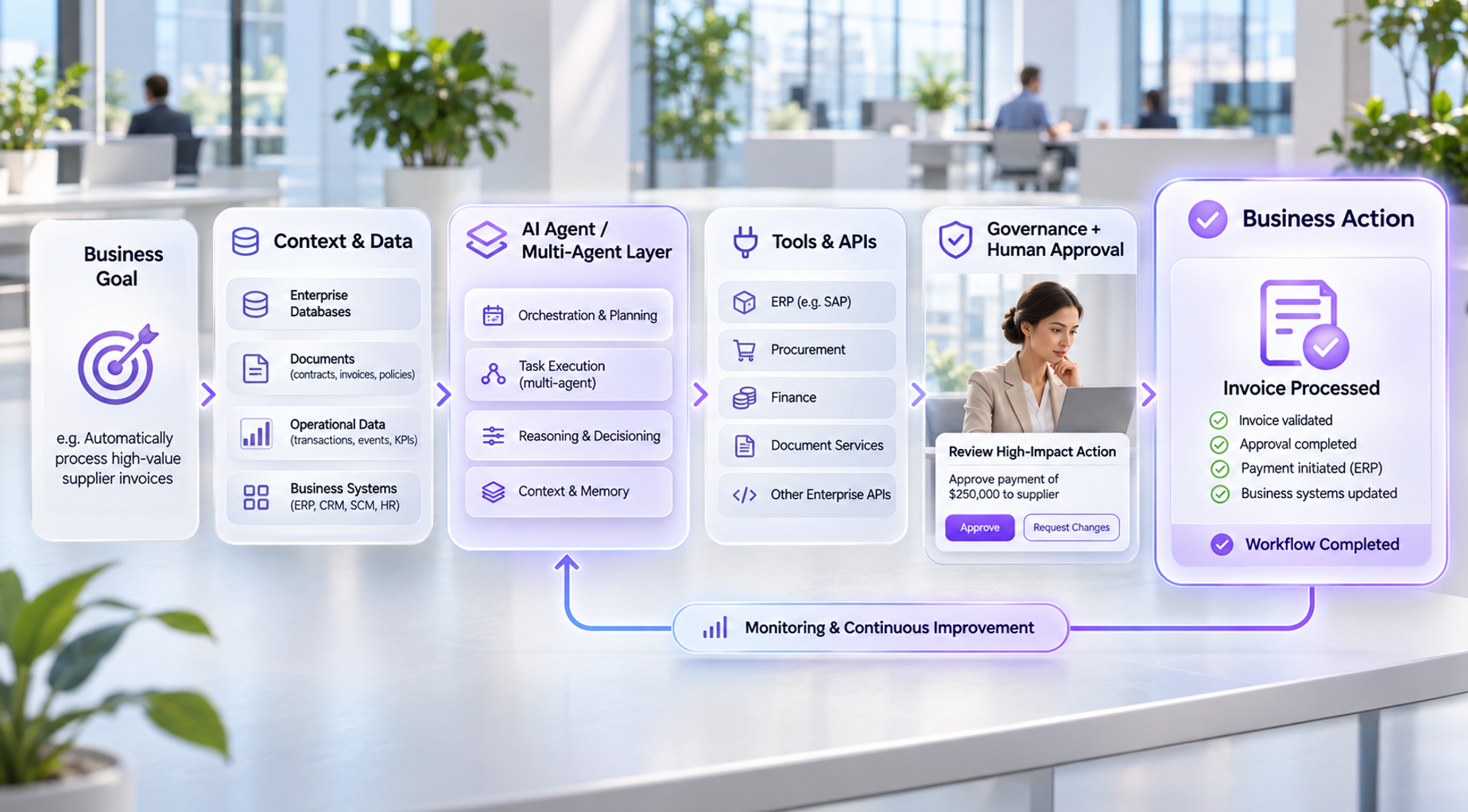
The value of an AI agent is not simply that it can generate an answer. It is that it can understand a goal, work with the right context, use connected tools and systems, and move a workflow toward an outcome.
From answering questions to completing work
Traditional software generally follows predefined instructions:
Input → Rules → Output
A copilot adds intelligence to the interaction:
Question → AI → Answer
An agentic workflow goes further:
Goal → Context → Reasoning → Tools → Action → Verification
Consider a procurement request for a component that is urgently needed.
A conventional AI assistant might identify suppliers and summarize their prices. An operational AI agent could check current inventory, review approved suppliers, compare delivery dates, examine purchasing policies and prepare a recommendation for approval.
The difference is not simply better AI.
The agent is connected to the workflow around the decision.
Google Cloud describes agentic workflows as AI-driven processes in which agents can reason, plan, use external tools and adapt their actions to achieve multi-step goals.
An agent is only as useful as the systems around it
This is where many Agentic AI discussions become too simplistic.
Connecting a large language model to a chat interface does not automatically create a useful enterprise agent.
An enterprise agent needs access to the information required to understand its task and the systems required to perform it.
That could include ERP and CRM platforms, operational databases, documents, APIs, IoT data, internal policies and analytics systems.
Without those connections, an agent may be intelligent but operationally isolated.
IBM's guidance on deploying AI agents similarly emphasizes connecting agents with enterprise data, applications and business tools so they can participate in real workflows rather than remain isolated prototypes. IBM - AI Agent Deployment
Context is what separates an agent from a chatbot
A powerful model is still limited if it does not understand the situation around a task.
Take the same procurement example.
The agent needs more than supplier names and prices. It may need to understand current inventory, approved vendors, historical delivery performance, purchasing limits and the urgency of the requirement.
The recommendation changes because the context changes.
This is one of the most important principles in enterprise Agentic AI:
The model provides reasoning capability. The surrounding system provides operational context.
That distinction becomes even more important in environments where decisions depend on live operational information.
For example, an industrial agent may need to combine sensor readings, maintenance history, production schedules and asset information before recommending an action.
The intelligence is not coming from one source.
It comes from connecting the sources that matter.
Tools turn reasoning into action
An AI agent becomes operational when it can interact with systems rather than simply describe what should happen.
Tools can allow an agent to retrieve information from a database, query an enterprise application, call an API, create or update a record, initiate a workflow or request human approval.
This is where Agentic AI starts to resemble an intelligent software system rather than an advanced chatbot.
But tool access introduces another engineering question:
What is the agent actually allowed to do?
An agent that can read a database is different from one that can modify it.
An agent that can recommend an action is different from one that can execute it.
The architecture has to define both capabilities and boundaries.
Autonomy needs boundaries
The goal of Agentic AI should not be to remove people from every workflow.
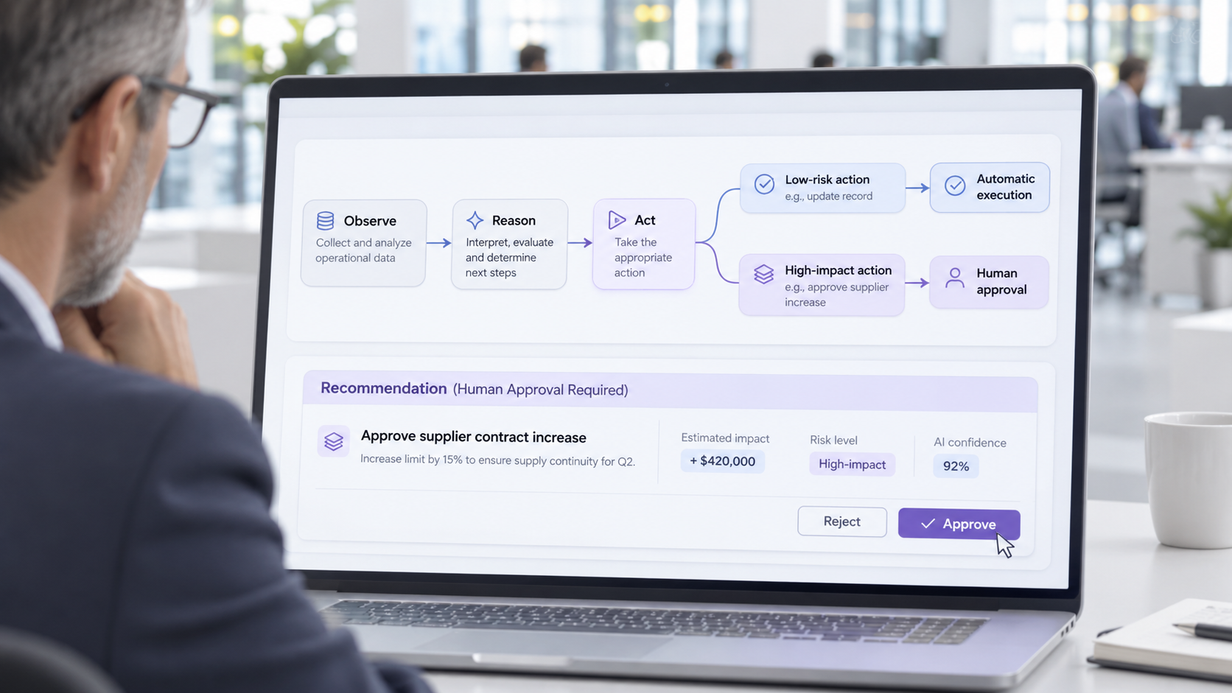
Some actions are repetitive and low-risk. Others can have financial, operational, safety or regulatory consequences.
A well-designed system can treat them differently.
An agent might automatically classify a service request but require approval before issuing a purchase order. It might detect an equipment anomaly automatically but require an engineer to approve a maintenance intervention.
Anthropic's research on trustworthy agents highlights the importance of human control, security, transparency and privacy as agents gain greater ability to act. Anthropic - Trustworthy Agents
The right level of autonomy is therefore not a feature to maximize.
It is an engineering decision based on risk and consequence.
One agent is not always enough
Some workflows involve several different kinds of reasoning.
One agent may retrieve information. Another may analyze it. A third may validate the result. Another may coordinate the final workflow.
This is where multi-agent systems can be useful.
But adding more agents does not automatically make a system more intelligent.
If one well-designed agent can solve the problem reliably, introducing five agents may simply increase complexity, latency and opportunities for failure.
The architecture should follow the workflow.
More agents do not automatically mean more intelligence.
The real engineering problem is the workflow
The strongest Agentic AI implementations start with the work itself.
Not the model.
Not the chatbot interface.
Not the latest AI framework.
Start with a process that contains repeated decisions, information gathering, coordination or manual handoffs.
Then ask:
What is the goal?
What information is required?
Which systems contain that information?
What decisions need to be made?
Which actions can be automated?
Where should a human remain involved?
How will the result be verified?
This changes the question from:
“Where can we use AI?”
to:
“Which part of this workflow can be made significantly better with an intelligent system?”
That is a much stronger starting point.
What does a production-ready AI agent look like?
A production agent needs more than a good prompt and a capable model.
It needs reliable data access, controlled tool permissions, authentication, observability, evaluation, error handling and clear operating boundaries.
It also needs to be monitored after deployment.
An agent may perform well during a pilot and still behave differently when it encounters new data, changed business rules or unexpected system conditions.
IBM's current work on scaling agentic AI emphasizes the connection between people, business processes and technology, along with governance, monitoring and continuous improvement. IBM - Preparing Your Enterprise to Put AI Agents Into Action
This is why production Agentic AI is ultimately a systems-engineering problem.
Where Agentic AI becomes genuinely valuable
The strongest opportunities are usually workflows where people spend significant time gathering information, coordinating systems and making repeatable decisions.
That can include procurement, customer operations, maintenance, compliance, internal knowledge workflows, reporting and IT operations.
The industry is less important than the structure of the workflow.
If an agent can combine information from multiple systems, reason about the situation and safely take the next step, it can reduce the distance between information and action.
This is also where Agentic AI starts connecting with other intelligent-system technologies.
In an industrial environment, an agent might consume Industrial IoT data, use a Digital Twin for asset context and interact with enterprise systems to move a workflow forward.
Neurom's approach brings these capabilities together rather than treating AI as an isolated layer: Agentic AI can work alongside Industrial IoT, Digital Twins and Forward Deployed Engineering when the system needs to operate inside a real technical environment.
Agentic AI should fit into the architecture, not sit beside it
An AI experiment can demonstrate that an agent can complete a task.
A production system has harder questions to answer.
What data can the agent access?
Which systems can it call?
What actions can it perform?
How is its identity managed?
What happens when a tool fails?
How is an incorrect decision detected?
When must a human intervene?
How is performance measured?
What happens when the underlying business process changes?
These are not secondary implementation details.
They are part of the Agentic AI architecture.
This is the engineering perspective behind Neurom's Agentic AI services: connecting intelligent agents to the data, systems and
workflows where decisions actually happen, rather than treating the agent as a standalone chatbot.
From Copilot to operational intelligence
The evolution of enterprise AI is not simply:
Chatbot → Better Chatbot → Agent
It is closer to:
Information → Understanding → Decision → Action → Feedback
A copilot can make a person faster.
An agent can help move a workflow forward.
A well-engineered agentic system can connect data, reasoning, enterprise systems and human oversight into a continuous operational loop.
That is where the real opportunity lies.
The goal is not to give every employee an AI agent.
The goal is to identify where intelligent systems can remove unnecessary friction between what an organization knows and what it needs to do next.
That is the shift from AI that answers questions to AI that helps execute work.
Frequently Asked Questions
What is Agentic AI?
Agentic AI refers to AI systems that can pursue goals through reasoning, planning, tool use and actions rather than only generating a response to a prompt. The level of autonomy depends on how the system is designed and governed.
What is the difference between Agentic AI and a copilot?
A copilot primarily assists a person by generating information, recommendations or content. An agent can go further by using tools, interacting with connected systems and executing parts of a workflow within defined permissions and boundaries.
How do AI agents interact with enterprise systems?
AI agents can interact with enterprise systems through APIs, databases, software tools and controlled interfaces. These connections allow an agent to retrieve information, update records, initiate workflows or coordinate actions across applications.
Is Agentic AI the same as automation?
No. Traditional automation generally follows predefined rules and workflows. Agentic AI can interpret goals, reason about changing conditions and dynamically determine which tools or steps are needed. The two can also work together.
Are multi-agent systems always better?
No. Multi-agent systems are useful when a problem naturally divides into specialized responsibilities. For simpler workflows, a single well-designed agent may be more reliable and easier to govern.
Is human approval required for Agentic AI?
Not for every action. Low-risk, well-defined actions can potentially be automated, while high-impact actions may require human approval. The appropriate level of human involvement depends on the risk and consequences of the workflow.
What makes an enterprise AI agent production-ready?
A production-ready agent needs reliable data and integrations, controlled permissions, evaluation, monitoring, error handling, security, governance and clear boundaries for autonomous action. It also needs continuous evaluation after deployment.
Is your AI still answering questions-or is it ready to move work forward?
hello@neurom.in
- Agentic AI
- AI Agents
- Enterprise AI
- AI Automation
- 1. Multi-Agent Systems